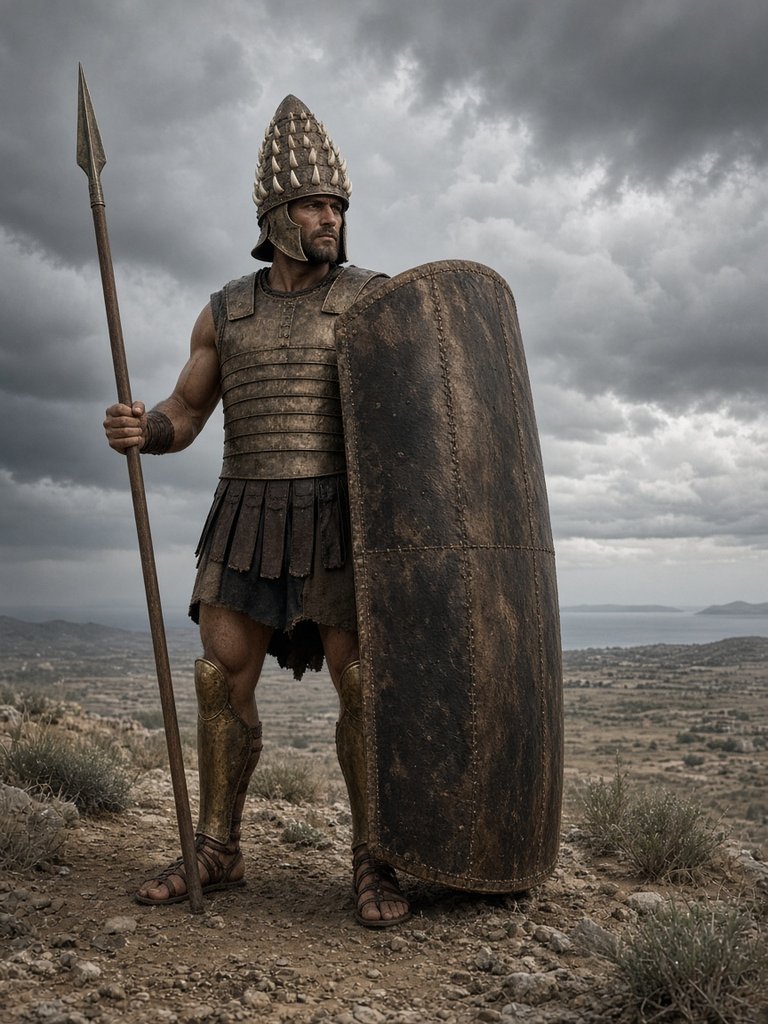
Aias (Ajax), son of Telamon king of Salamis, is the tallest and strongest of the Achaeans after Achilles. From the walls of Troy Priam asks who is the warrior whose head and shoulders tower above the rest, and Helen answers that it “is huge Ajax, bulwark of the Achaeans” (Iliad 3.229, tr. Butler). He carries a great shield of seven ox-hides faced with bronze (Iliad 7.219–223, paraphrased).
He fights Hektor in single combat until nightfall, and the two part with gifts, a sword for a belt (Iliad 7.206–305, paraphrased); later he stands almost alone on the ships against the Trojan fire (Iliad 15.674–746). When the armour of Achilles was given to Odysseus instead of to him, he went mad and killed himself (Sophocles, Ajax, paraphrased). In the underworld Odysseus says that of all the ghosts “that of Ajax son of Telamon alone held aloof—still angry with me for having won the cause in our dispute about the armour of Achilles” (Odyssey 11.543–546, tr. Butler).
Aias was a hero of Salamis and of Athens. Kleisthenes named one of the ten Athenian tribes, Aiantis, after him (Herodotus 5.66), and before the battle of Salamis the Greeks prayed to the gods and called Aias and Telamon to their aid from Salamis (Herodotus 8.64, paraphrased). Pausanias saw his sanctuary and image on Salamis (1.35.2–3).
Epithets
- ἕρκος Ἀχαιῶν · herkos Achaiōn
- bulwark of the Achaeans (Iliad 3.229)
- Τελαμώνιος · Telamōnios
- son of Telamon
- πελώριος · pelōrios
- huge
Symbols and virtues
Strength, steadfastness and honour, and the pride that cannot bear defeat. Symbols: the tower shield of seven hides, the sword of Hektor.
Myths
- On the walls. Iliad 3.226–229.
- Duel with Hektor. Iliad 7.206–305.
- Defender of the ships. Iliad 15.674–746.
- The judgment of the arms. Odyssey 11.543–564; Sophocles, Ajax.
Cult and places
- Salamis. Sanctuary and image (Pausanias 1.35.2–3); called on before the battle (Herodotus 8.64).
- Athens. The tribe Aiantis (Herodotus 5.66).
In the poets
“The ghosts of other dead men stood near me and told me each his own melancholy tale; but that of Ajax son of Telamon alone held aloof—still angry with me for having won the cause in our dispute about the armour of Achilles.”Homer, Odyssey 11.541–546, tr. Samuel Butler (1900), public domain.
Sources
Homer, Iliad 3.226–229, 7.206–305, 15.674–746; Odyssey 11.543–564; Sophocles, Ajax; Herodotus 5.66, 8.64; Pausanias 1.35.2–3.
Quotations in public-domain translations (Evelyn-White 1914, Butler 1898/1900, Taylor 1792); other authors paraphrased.