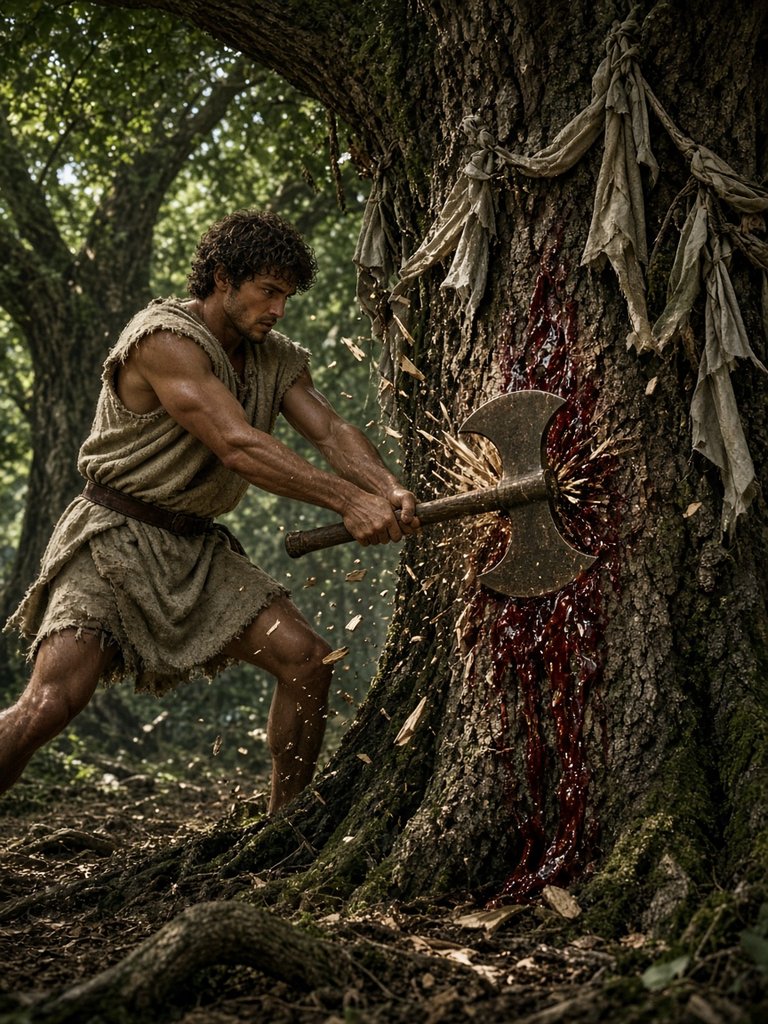
Erysichthon, son of Triopas, lived in Thessaly near Dotion, where the Pelasgians had planted a sacred grove for Demeter. In Callimachus’ Hymn to Demeter he went with twenty servants and axes to cut down its great poplar for a feasting hall (Hymn 6.24–40, paraphrased).
The goddess came to him in the form of her priestess Nikippe and begged him to stop. He threatened her with the axe, and she, resuming her own shape, cursed him with a hunger that could never be filled. He ate everything in his father’s house, the cattle, the horses, even the cat, until the king’s son sat begging at the crossroads for scraps (Hymn 6.41–117, paraphrased).
Ovid tells the story with a sacred oak whose wound runs with blood. Erysichthon sold his daughter Mestra to buy food, but she had from Poseidon the power to change her shape and escaped each buyer; at last he began to devour his own body (Metamorphoses 8.738–878, paraphrased).
Epithets
- Τριοπίδας · Triopidas
- son of Triopas
Symbols and virtues
Sacrilege and insatiable appetite. Symbols: the axe, the sacred tree, the empty dish.
Myths
- The sacred grove of Demeter. Callimachus, Hymn 6.24–40.
- The warning and the curse. Callimachus, Hymn 6.41–67.
- The insatiable hunger. Callimachus, Hymn 6.68–117.
- Mestra and the end. Ovid, Metamorphoses 8.843–878.
Sources
Hesiodic Catalogue fr. 43a; Callimachus, Hymn 6 to Demeter; Ovid, Metamorphoses 8.738–878.
Quotations in public-domain translations (Evelyn-White 1914, Butler 1898/1900, Taylor 1792); other authors paraphrased.