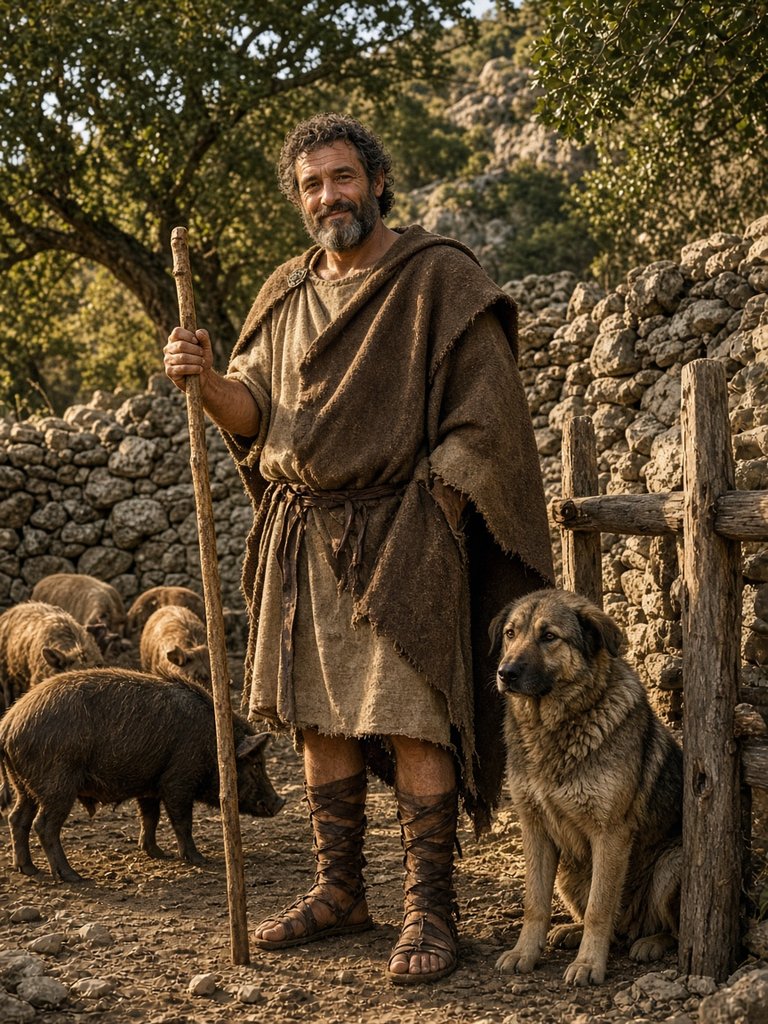
Eumaios is the swineherd of Odysseus on Ithaka. He was born a prince, son of Ktesios king of the island of Syrie, but as a child he was carried off by a Phoenician nurse and sold to Laertes, who raised him with his own daughter (Odyssey 15.403–484, paraphrased).
When Odysseus comes home disguised as a beggar, Eumaios takes him into his hut, kills two pigs for him and gives him his own bed of fleeces, saying: “Stranger, though a still poorer man should come here, it would not be right for me to insult him, for all strangers and beggars are from Jove” (Odyssey 14.56–58, tr. Butler). Homer often speaks to him directly in the second person, “O swineherd Eumaeus”, a mark of affection.
He welcomes Telemachos home like a father greeting a son (Odyssey 16.11–21), is shown the scar and promised freedom and a house (Odyssey 21.188–227), and fights beside Odysseus against the suitors (Odyssey 22).
Epithets
- δῖος ὑφορβός · dios huphorbos
- the noble swineherd
- ὄρχαμος ἀνδρῶν · orchamos andrōn
- leader of men
Symbols and virtues
Loyalty and hospitality from the humble. Symbols: the staff, the swine, the dogs, the hut of fleeces.
Myths
- A stolen prince. Odyssey 15.403–484.
- The beggar in the hut. Odyssey 14.
- Telemachos’ return. Odyssey 16.1–155.
- Against the suitors. Odyssey 21–22.
In the poets
“Stranger, though a still poorer man should come here, it would not be right for me to insult him, for all strangers and beggars are from Jove.”Homer, Odyssey 14.56–58, tr. Samuel Butler (1900), public domain.
Sources
Homer, Odyssey 14, 15.301–495, 16.1–155, 17.182–606, 21.188–244, 22.
Quotations in public-domain translations (Evelyn-White 1914, Butler 1898/1900, Taylor 1792); other authors paraphrased.