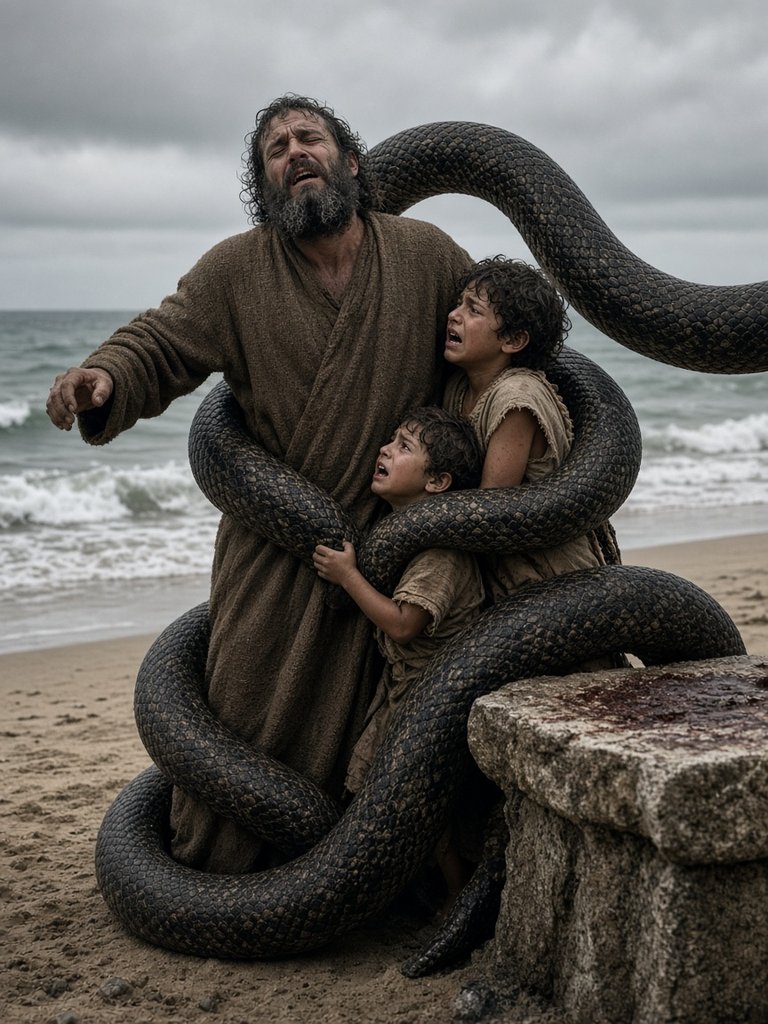
Laokoon was a Trojan priest, of Apollo in the Greek tradition and chosen by lot as priest of Neptune in Virgil (Hyginus, Fabulae 135; Virgil, Aeneid 2.201, paraphrased). The early epic Sack of Ilion already told how two serpents killed him and one of his sons, a sign that sent Aineias away to Ida (Proclus’ summary, paraphrased).
In Virgil, when the Trojans found the wooden horse on the shore, Laokoon ran down from the citadel crying that they should fear the Greeks even when they brought gifts, and hurled his spear into the horse’s flank, so that its hollow belly rang (Aeneid 2.40–56, paraphrased). Sinon’s false tale then persuaded the Trojans otherwise.
As Laokoon sacrificed a bull at the altar, two huge serpents swam over the calm sea from Tenedos, seized his two young sons and then the father himself, crushing them in their coils, and glided away to the shrine of Athena. The Trojans took it as punishment for wounding a sacred offering and dragged the horse into the city (Aeneid 2.199–249, paraphrased). Pliny praises the marble group of the death by three Rhodian sculptors (Natural History 36.37, paraphrased).
Epithets
- Λαοκόων · Laokoōn
- Laocoon
Symbols and virtues
The true warning that is not believed. Symbols: the spear, the twin serpents, the altar.
Myths
- Death by the serpents in the Sack of Ilion. Proclus, Chrestomathy (Iliou Persis).
- Warning against the horse. Virgil, Aeneid 2.40–56.
- The serpents from Tenedos. Virgil, Aeneid 2.199–227.
- Priest of Apollo. Hyginus, Fabulae 135.
Sources
Proclus, Chrestomathy (Iliou Persis); Virgil, Aeneid 2.40–56, 2.199–249; Quintus Smyrnaeus 12.389–499; Hyginus, Fabulae 135; Pliny, Natural History 36.37.
Quotations in public-domain translations (Evelyn-White 1914, Butler 1898/1900, Taylor 1792); other authors paraphrased.