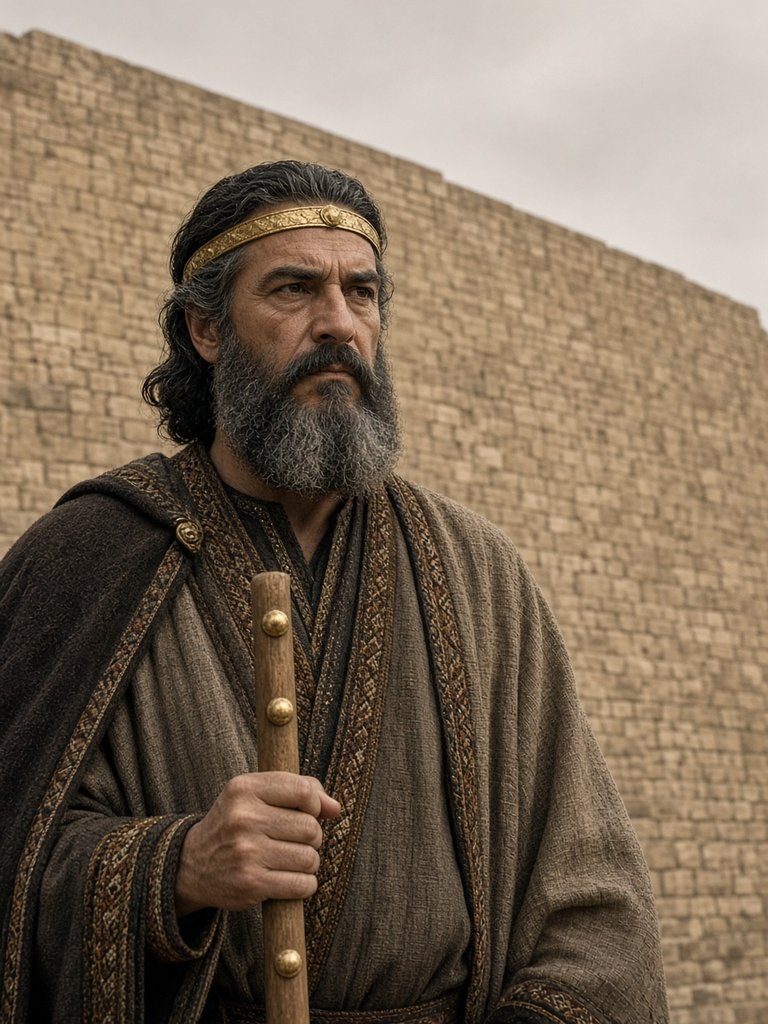
Laomedon, son of Ilos, was king of Troy and father of Priam and Tithonos (Iliad 20.236–237). Poseidon and Apollo served him for a year at a fixed wage, Poseidon building the walls of Troy and Apollo herding his cattle on Ida. Poseidon remembers how it ended: “mighty Laomedon robbed us of all our hire and sent us off with nothing but abuse. He threatened to bind us hand and foot and sell us over into some distant island” (Iliad 21.441–454, tr. Butler).
Poseidon sent a sea-monster against Troy, and the Trojans and Athena built an earthwork for Herakles to shelter in when he fought it (Iliad 20.144–148, paraphrased). Laomedon’s daughter Hesione had been exposed to the monster; Herakles saved her in return for the divine horses Zeus had given for Ganymedes, but Laomedon refused to pay (Apollodorus 2.5.9, paraphrased).
Herakles came back with six ships and sacked the city. Sarpedon says: “your father overthrew Ilius by reason of Laomedon’s folly in refusing payment to one who had served him well” (Iliad 5.648–650, tr. Butler). Laomedon and all his sons but Priam were killed, and Hesione was given to Telamon (Apollodorus 2.6.4, paraphrased).
Epithets
- Λαομεδοντιάδης · Laomedontiadēs
- son of Laomedon, said of Priam
Symbols and virtues
The broken bargain and its punishment. Symbols: the walls of Troy, the divine horses.
Myths
- The gods’ year of service. Iliad 21.441–457.
- The sea-monster and Hesione. Iliad 20.144–148; Apollodorus 2.5.9.
- Herakles sacks Troy. Iliad 5.640–651; Apollodorus 2.6.4.
In the poets
“Mighty Laomedon robbed us of all our hire and sent us off with nothing but abuse.”Homer, Iliad 21.451–452, tr. Samuel Butler (1898), public domain.
Sources
Homer, Iliad 5.638–651, 7.452–453, 20.144–148, 20.236–237, 21.441–457; Apollodorus 2.5.9, 2.6.4.
Quotations in public-domain translations (Evelyn-White 1914, Butler 1898/1900, Taylor 1792); other authors paraphrased.