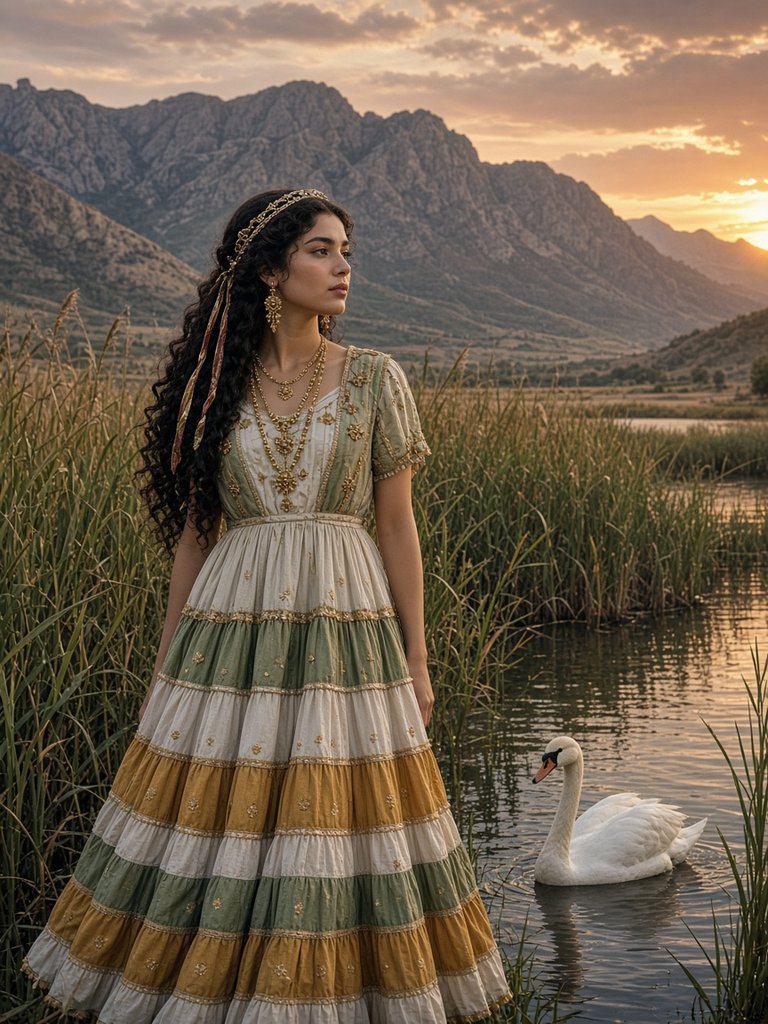
Leda, daughter of Thestios, is the wife of Tyndareus king of Sparta. Odysseus sees her among the heroines in the underworld: “And I saw Leda the wife of Tyndarus, who bore him two famous sons, Castor breaker of horses, and Pollux the mighty boxer” (Odyssey 11.298–300, tr. Butler).
Later tradition says Zeus came to her in the form of a swan (Euripides, Helen 17–21, paraphrased). Of her children, Helen and Polydeukes were usually counted as children of Zeus and Klytaimnestra and Kastor as children of Tyndareus, and some told that Helen was hatched from an egg (Apollodorus 3.10.7, paraphrased).
Her twin sons are the Dioskouroi, who share immortality on alternate days (Odyssey 11.301–304). At Sparta Pausanias saw, hanging from the roof of the sanctuary of Hilaeira and Phoibe, an egg tied with ribbons that was said to be the egg Leda bore (3.16.1, paraphrased).
Epithets
- Θεστιάς · Thestias
- daughter of Thestios
- Τυνδαρέου παράκοιτις · Tundareou parakoitis
- wife of Tyndareus (Odyssey 11.298)
Symbols and virtues
The mother of twin houses, mortal and divine. Symbols: the swan, the egg.
Myths
- Among the heroines. Odyssey 11.298–304.
- Zeus as a swan. Euripides, Helen 17–21.
- The egg. Apollodorus 3.10.7.
Cult and places
- Sparta. The egg in the sanctuary of Hilaeira and Phoibe (Pausanias 3.16.1).
In the poets
“And I saw Leda the wife of Tyndarus, who bore him two famous sons, Castor breaker of horses, and Pollux the mighty boxer.”Homer, Odyssey 11.298–300, tr. Samuel Butler (1900), public domain.
Sources
Homer, Odyssey 11.298–304; Euripides, Helen 16–22; Apollodorus 3.10.5–7; Pausanias 3.16.1.
Quotations in public-domain translations (Evelyn-White 1914, Butler 1898/1900, Taylor 1792); other authors paraphrased.