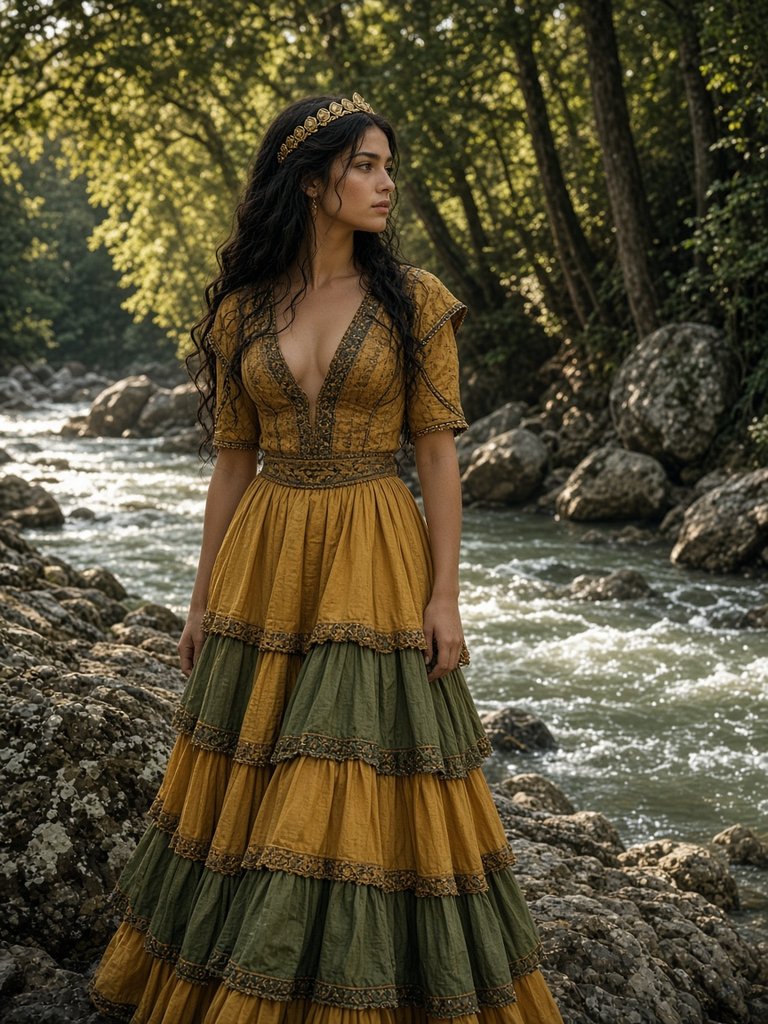
Marpessa was the daughter of Euenos, son of Ares. Idas carried her off in a winged chariot given him by Poseidon; her father pursued them, and when he could not catch them, killed his horses and threw himself into the river Lykormas, which was afterwards called Euenos (Apollodorus 1.7.8, paraphrased).
Apollo also loved her and tried to take her from Idas, and the mortal faced the god. The Iliad recalls Kleopatra, “who was daughter of Marpessa daughter of Euenus, and of Ides the man then living. He it was who took his bow and faced King Apollo himself for fair Marpessa’s sake” (Iliad 9.557–560, tr. Butler).
Zeus parted them and let Marpessa choose; she chose Idas, fearing that the god would desert her when she grew old (Apollodorus 1.7.9, paraphrased). Her daughter, also called Alkyone in memory of her mother’s mourning, became the wife of Meleagros (Iliad 9.561–565, paraphrased).
Epithets
- Εὐηνίνη · Euēninē
- daughter of Euenos (Iliad 9.557)
Symbols and virtues
Choice of mortal love over a god’s. Symbols: the river, the winged chariot, the bow of Idas.
Myths
- Carried off by Idas. Apollodorus 1.7.8.
- Idas against Apollo. Iliad 9.557–564.
- Her choice. Apollodorus 1.7.9.
- Mother of Kleopatra, wife of Meleagros. Iliad 9.556–565.
In the poets
“He it was who took his bow and faced King Apollo himself for fair Marpessa’s sake.”Homer, Iliad 9.559–560, tr. Samuel Butler (1898), public domain.
Sources
Homer, Iliad 9.556–565; Simonides fr. 563; Bacchylides 20; Apollodorus 1.7.8–9; Pausanias 5.18.2.
Quotations in public-domain translations (Evelyn-White 1914, Butler 1898/1900, Taylor 1792); other authors paraphrased.