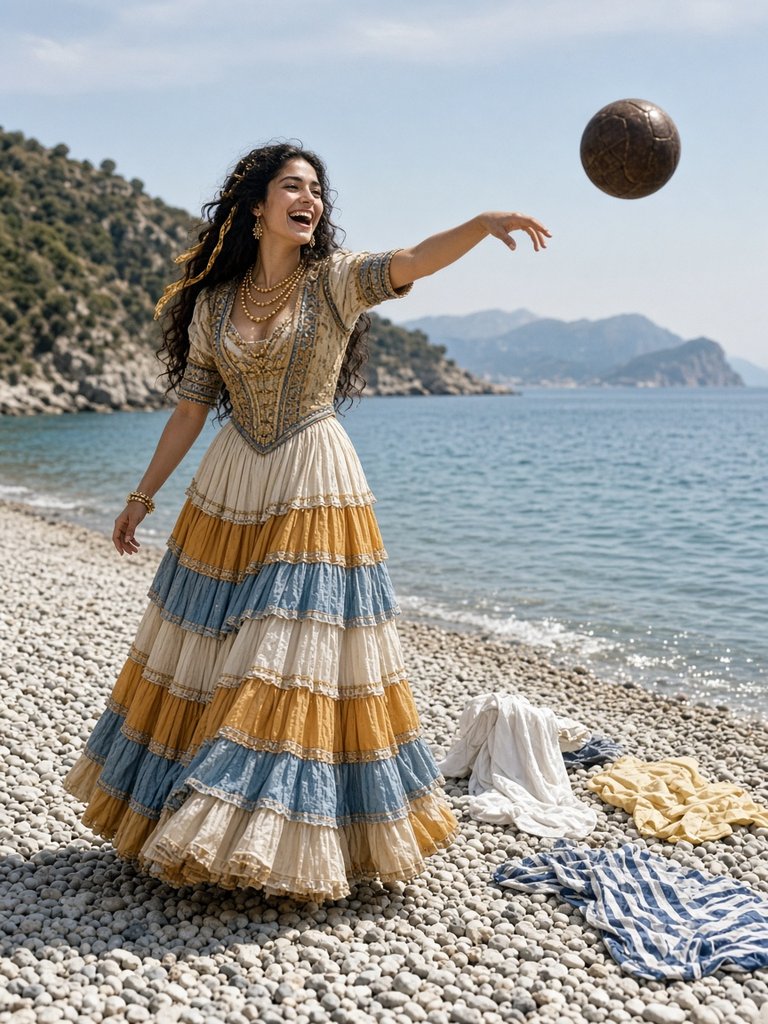
Nausikaa is the daughter of Alkinoos and Arete, king and queen of the Phaiakians on Scheria. Athena comes to her in a dream and tells her to take the family’s clothes to the river to wash, for her wedding day cannot be far off (Odyssey 6.15–40, paraphrased).
While she and her maids play ball after the washing, the shipwrecked Odysseus wakes in the bushes. The maids run, but she stands her ground; he compares her to a young palm he once saw at Delos, and she gives him clothes, food and the way to her father’s palace (Odyssey 6.85–315, paraphrased).
When he is bathed and dressed for the feast she meets him once more: “Farewell stranger,” said she, “do not forget me when you are safe at home again, for it is to me first that you owe a ransom for having saved your life” (Odyssey 8.461–462, tr. Butler).
Epithets
- λευκώλενος · leukōlenos
- white-armed (Odyssey 6.101)
- θυγάτηρ μεγαλήτορος Ἀλκινόοιο · thugatēr megalētoros Alkinooio
- daughter of great-hearted Alkinoos
Symbols and virtues
Kindness to the stranger, courage and grace. Symbols: the ball, the washing at the river, the palm at Delos.
Myths
- Athena’s dream. Odyssey 6.15–40.
- Meeting Odysseus. Odyssey 6.85–315.
- Farewell. Odyssey 8.457–468.
In the poets
“Farewell stranger,” said she, “do not forget me when you are safe at home again, for it is to me first that you owe a ransom for having saved your life.”Homer, Odyssey 8.461–462, tr. Samuel Butler (1900), public domain.
Sources
Homer, Odyssey 6, 7.1–13, 8.457–468.
Quotations in public-domain translations (Evelyn-White 1914, Butler 1898/1900, Taylor 1792); other authors paraphrased.