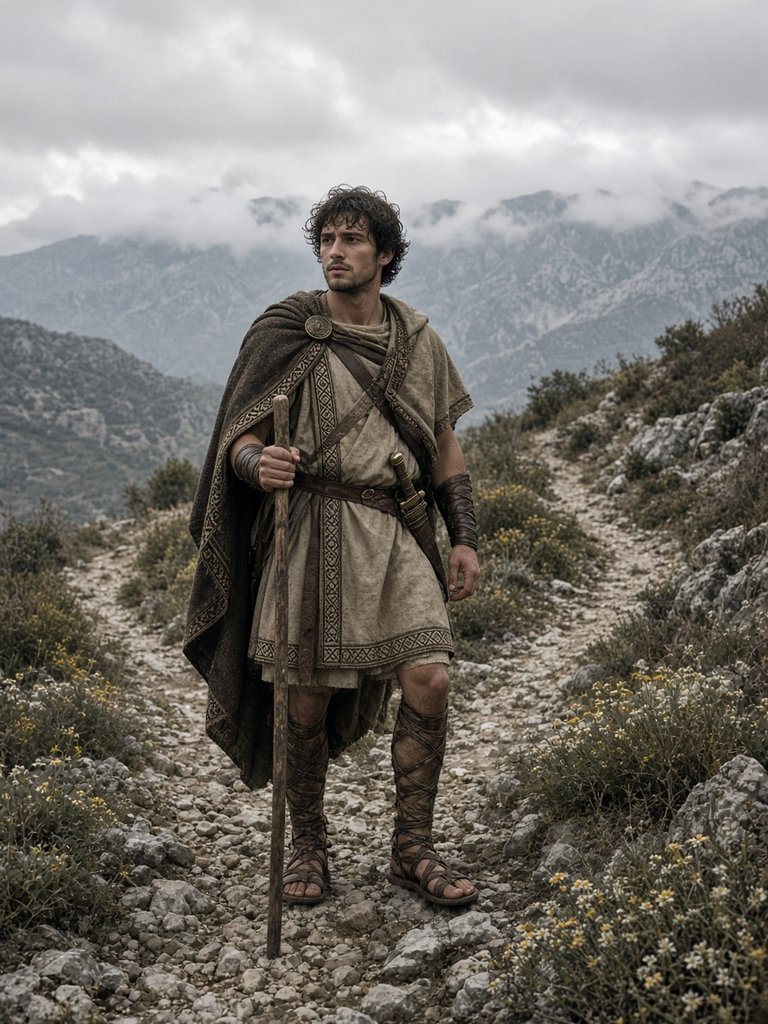
Oidipous (Oedipus) is the son of Laios king of Thebes and his wife, whom Homer calls Epikaste and the tragedians Iokaste. Warned by Apollo that his son would kill him, Laios had the infant exposed on Mount Kithairon with his ankles pierced; a shepherd saved him and he was raised as the son of the king and queen of Corinth (Sophocles, Oedipus the King 711–722, 1022–1040, paraphrased).
On the road from Delphi he killed an old man at a crossroads, not knowing that it was Laios. At Thebes he answered the riddle of the Sphinx and freed the city, and was given the throne and the widowed queen. The Odyssey tells the story in a few lines: “I also saw fair Epicaste mother of king Oedipodes whose awful lot it was to marry her own son without suspecting it. He married her after having killed his father, but the gods proclaimed the whole story to the world” (Odyssey 11.271–274, tr. Butler). When the truth came out she hanged herself, and Homer has him rule on in grief over Thebes while “the avenging spirits haunted him as for an outraged mother—to his ruing bitterly thereafter” (Odyssey 11.275–280, tr. Butler).
In Sophocles he blinds himself and goes into exile, led by his daughter Antigone, and dies at Kolonos near Athens, taken mysteriously by the gods and promised as a protecting presence for the land that received him (Oedipus at Colonus 1518–1555, 1586–1666, paraphrased). His curse on his sons Eteokles and Polyneikes led to the war of the Seven against Thebes. Pausanias saw his hero-shrine at Athens on the Areopagus, where his bones were said to lie, and records the spring at Thebes where he washed off his father’s blood (1.28.7, 9.18.6, paraphrased).
Epithets
- Οἰδιπόδης · Oidipodēs
- Homer’s form of his name (Odyssey 11.271)
- ἄναξ Καδμείων · anax Kadmeiōn
- lord of the Kadmeians (Odyssey 11.276)
Symbols and virtues
The mind that solves every riddle but its own; fate, guilt and the blessing of the suppliant. Symbols: the pierced ankles, the crossroads, the riddle of the Sphinx, the staff of the blind exile.
Myths
- Exposed on Kithairon. Sophocles, Oedipus the King 711–722, 1022–1040.
- The crossroads. Oedipus the King 800–813.
- The Sphinx. Apollodorus 3.5.8.
- Epikaste. Odyssey 11.271–280.
- Kolonos. Sophocles, Oedipus at Colonus.
Cult and places
- Athens. Hero-shrine on the Areopagus (Pausanias 1.28.7); Kolonos (Pausanias 1.30.4).
- Thebes. The spring of Oidipous (Pausanias 9.18.6).
In the poets
“I also saw fair Epicaste mother of king Oedipodes whose awful lot it was to marry her own son without suspecting it.”Homer, Odyssey 11.271–273, tr. Samuel Butler (1900), public domain.
Sources
Homer, Odyssey 11.271–280; Iliad 23.679–680; Sophocles, Oedipus the King, Oedipus at Colonus; Aeschylus, Seven against Thebes; Apollodorus, Library 3.5.7–9; Pausanias 1.28.7, 1.30.4, 9.18.6.
Quotations in public-domain translations (Evelyn-White 1914, Butler 1898/1900, Taylor 1792); other authors paraphrased.