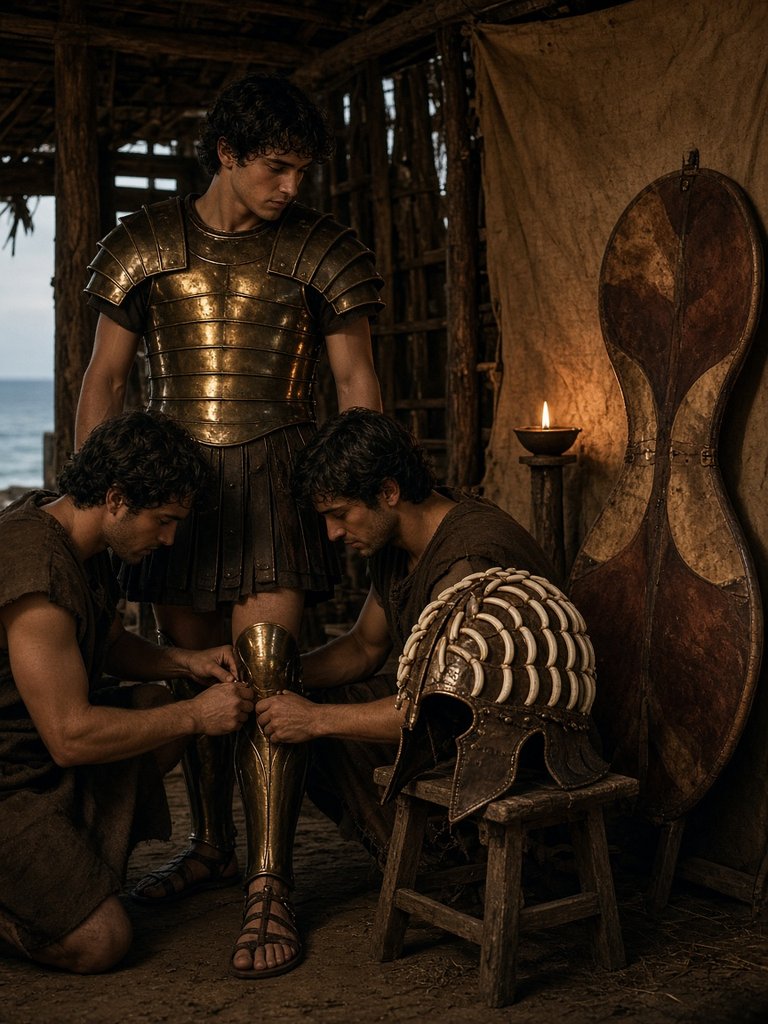
Patroklos, son of Menoitios, is the closest companion of Achilles. As a boy he killed another child in anger over a game of knucklebones, and his father brought him to Peleus, who raised him with Achilles (Iliad 23.84–90, paraphrased).
When the Trojans reach the ships he begs Achilles to let him fight in his armour. He drives them back and kills Sarpedon, son of Zeus, but Apollo strikes the armour from him, Euphorbos wounds him and Hektor kills him (Iliad 16, paraphrased). His death brings Achilles back to the war. His ghost comes to Achilles in sleep: “You sleep, Achilles, and have forgotten me; you loved me living, but now that I am dead you think for me no further. Bury me with all speed that I may pass the gates of Hades” (Iliad 23.69–71, tr. Butler).
Achilles holds his funeral with games (Iliad 23), and in the Odyssey the ghost of Agamemnon tells how the bones of Achilles and Patroklos were laid together in a golden urn given by Dionysos and made by Hephaistos (Odyssey 24.73–77, paraphrased).
Epithets
- Μενοιτιάδης · Menoitiadēs
- son of Menoitios
- ἱππεύς · hippeus
- horseman
Symbols and virtues
Friendship and gentleness, courage beyond one’s measure. Symbols: the borrowed armour, the golden urn.
Myths
- Raised by Peleus. Iliad 23.84–90.
- In Achilles’ armour. Iliad 16.1–100.
- Death. Iliad 16.783–867.
- The ghost. Iliad 23.62–107.
- The golden urn. Odyssey 24.73–77.
In the poets
“You sleep, Achilles, and have forgotten me; you loved me living, but now that I am dead you think for me no further.”Homer, Iliad 23.69–70, tr. Samuel Butler (1898), public domain.
Sources
Homer, Iliad 11.596–848, 16, 23; Odyssey 24.73–79.
Quotations in public-domain translations (Evelyn-White 1914, Butler 1898/1900, Taylor 1792); other authors paraphrased.