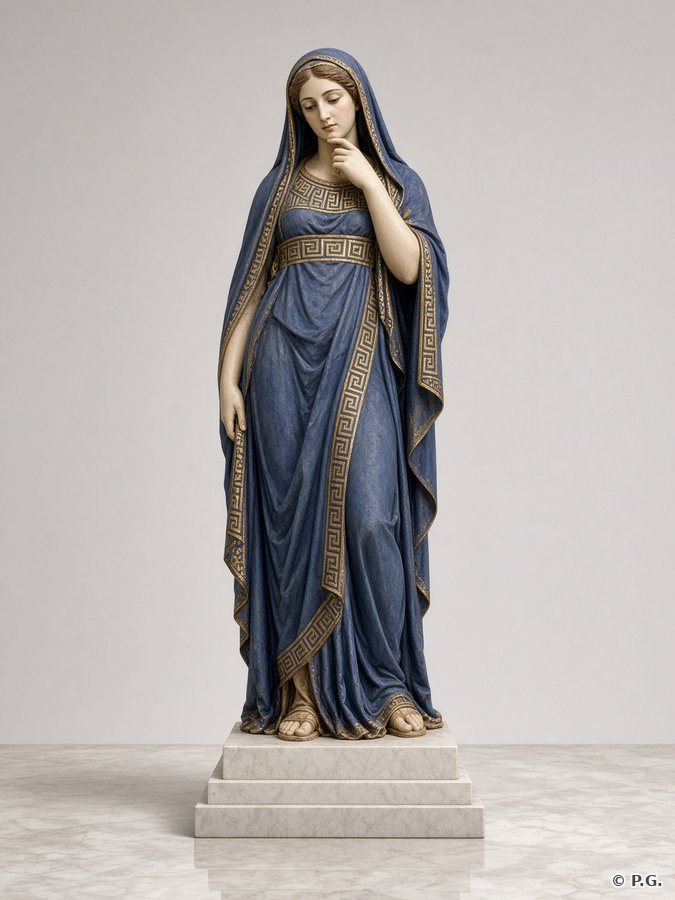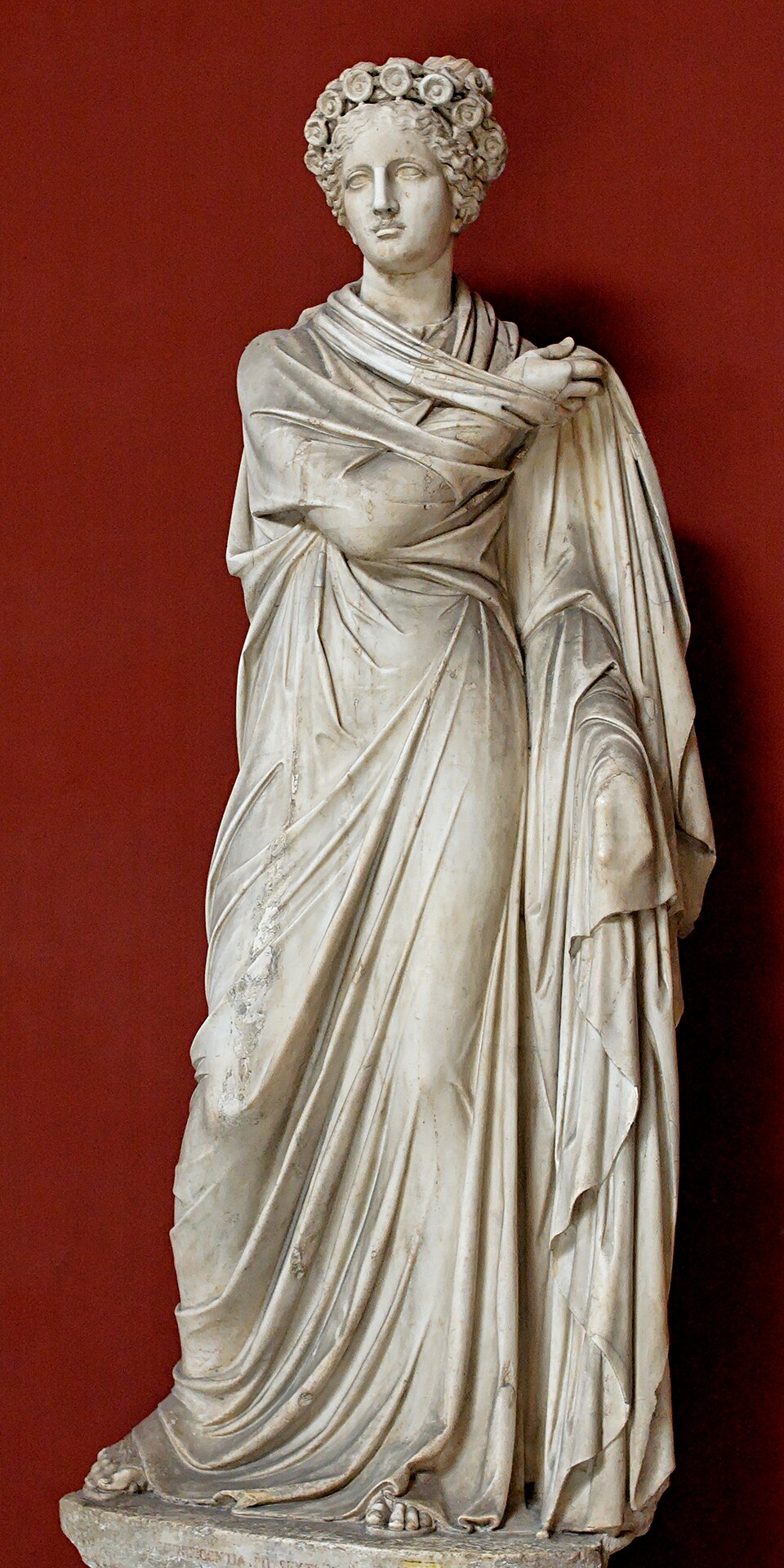
Jastrow, Public domain, via Wikimedia Commons

Polymnia is one of the nine Muses, daughters of Zeus and Mnemosyne (Memory), born in Pieria “a little way from the topmost peak of snowy Olympus” after Zeus lay with Mnemosyne nine nights (Theogony 53–62). Hesiod names the nine together: “Cleio and Euterpe, Thaleia, Melpomene and Terpsichore, and Erato and Polyhymnia and Urania and Calliope” (Theogony 77–79).
Hesiod calls her Polyhymnia, “of many hymns” (Theogony 78); the shorter Polymnia is the usual later form. Diodorus explains the name from the great praise by which she makes famous those whom the poets immortalise (Diodorus 4.7). She is the Muse of hymns to the gods, and in later tradition of sacred song, pantomime and meditation; Roman sculptors show her standing wrapped in her mantle, chin on hand, in thought.
Epithets
- Πολυύμνια · Polyhymnia
- of many hymns (Theogony 78)
- Πολύμνια · Polymnia
- the later short form
Domains and symbols
The hymn to the gods: sacred song, prayer and the stillness of thought before it. Admire: reverence, attention, the silence out of which a hymn comes. Sacred symbols: the veil and mantle; she is often shown without any object, in thought.
Myths
- Born of Memory. Daughter of Zeus and Mnemosyne, born in Pieria (Theogony 53–62).
- Hesiod’s calling. The Muses taught Hesiod “glorious song while he was shepherding his lambs under holy Helicon” and gave him a laurel staff (Theogony 22–34).
- Many hymns. Her name is the abundance of praise (Theogony 78; Diodorus 4.7.4).
- Song at the feast of the gods. “Apollo struck his lyre, and the Muses lifted up their sweet voices, calling and answering one another” (Iliad 1.603–604, tr. Butler).
- Lament for Achilles. “The nine muses also came and lifted up their sweet voices in lament—calling and answering one another” (Odyssey 24.60–61, tr. Butler).
Cult sites
- Mount Helikon. The grove of the Muses on Helikon above Thespiai held statues of all nine and the Hippokrene spring (Pausanias 9.29–31; Theogony 1–8).
- Athens. An altar of the Muses Ilissiades stood by the Ilissos (Pausanias 1.19.5).
- Troizen. An altar shared by the Muses and Sleep (Pausanias 2.31.3).
- Sparta. The Spartan king sacrificed to the Muses before battle (Plutarch, Lycurgus 21).
Festivals
- Mouseia. The Thespians held a festival and contests for the Muses on Helikon (Pausanias 9.31.3).
Offerings
Hesiod dedicated the tripod he won for a song at Chalkis to the Muses of Helikon, where they had first set him on the path of song (Works and Days 650–659). Today: a lamp, water or honey, and above all the work itself, a poem said, a song sung, a page read aloud.
Beneath the Divine Mind
Polymnia is the Divine Mind as praise: the soul turned back to its source in hymn. Every hymn on these pages is in some sense hers. Like every god she stands beneath the One (The One and the Many).
Honouring Polymnia today
- Hymn. Sing or recite a hymn to any god each morning.
- Silence. Keep a short silence before prayer.
- Hymn. Recite the Homeric Hymn to the Muses below.
Hymn
I will begin with the Muses and Apollo and Zeus. For it is through the Muses and Apollo that there are singers upon the earth and players upon the lyre; but kings are from Zeus. Happy is he whom the Muses love: sweet flows speech from his lips. Hail, children of Zeus! Give honour to my song! And now I will remember you and another song also.Homeric Hymn 25, To the Muses and Apollo. Tr. H. G. Evelyn-White (1914), public domain.
Sources
Hesiod, Theogony 1–115, esp. 22–34, 53–62, 75–103; Works and Days 656–659; Homeric Hymn 25; Homer, Iliad 1.603–604, Odyssey 24.60–62; Pausanias 1.19.5, 2.31.3, 9.29–31; Plutarch, Lycurgus 21; Diodorus Siculus 4.7.
Quotations in public-domain translations (Evelyn-White 1914, Butler 1898/1900, Taylor 1792); other authors paraphrased.