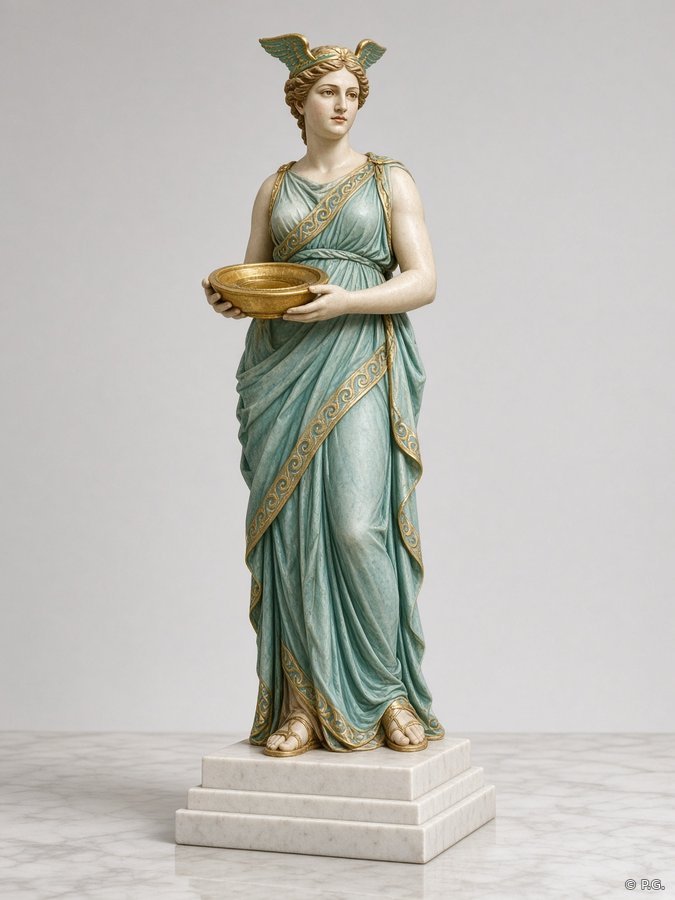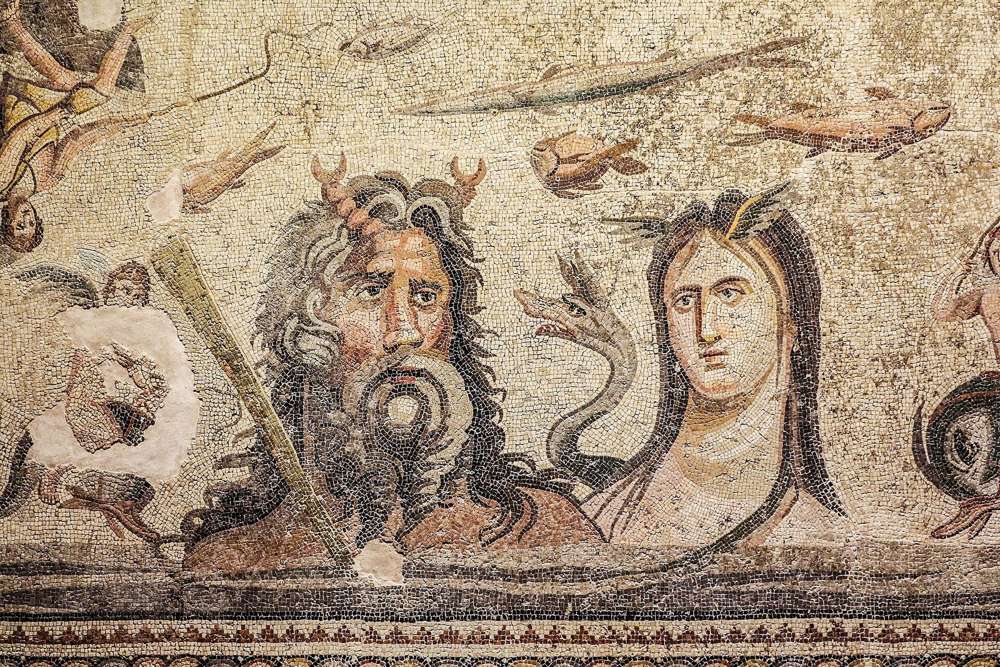
Bernard Gagnon, CC BY-SA 3.0, via Wikimedia Commons

Tethys, “lovely” Titaness, daughter of Ouranos and Gaia (Theogony 136), is the wife of Okeanos. To him she bore the rivers and the three thousand neat-ankled Okeanids, who watch over the earth and the deep waters (Theogony 337–370). Homer’s Hera calls them “Okeanos, from whom the gods are sprung, and mother Tethys”, who nursed her in their house when Zeus thrust Kronos beneath the earth (Iliad 14.201–204).
Epithets
- Ἐρατεινή · Erateine
- lovely (Theogony 136)
- Μήτηρ · Meter
- mother, of the gods in Homer (Iliad 14.201)
Domains and symbols
Fresh water flowing from the earth: rivers, springs and fountains; nursing and care. Admire: nurture. Sacred symbols: the river, the water jar, the sea creatures of the mosaics.
Myths
- Mother of rivers. Neilos, Alpheios, Eridanos, Strymon, Maiandros, Istros and the rest, and the Okeanids (Theogony 337–370).
- Nurse of Hera. Rhea gave Hera to Okeanos and Tethys to rear while Zeus fought Kronos (Iliad 14.200–204).
- The quarrel. Hera pretends to go to reconcile them, for they had long kept apart from each other’s bed (Iliad 14.205–210).
Offerings
Fresh water and aromatics. Today: offer spring water and pray for rivers and wells.
Beneath the Divine Mind
Tethys is the Divine Mind as nurture: the flowing water that feeds and rears, personified and deified as the mother of rivers. Plato read Homer’s pair as a teaching that all things flow (Theaetetus 152e). Like every god she stands beneath the One (The One and the Many).
Honouring Tethys today
- Offerings. Pour spring water.
- Hymn. Recite the Orphic hymn below.
Hymn
Tethys I call, with eyes cærulean bright, hid in a veil obscure from human sight; great Okeanos’ empress, wand’ring thro’ the deep, and pleas’d with gentle gales, the earth to sweep.Orphic Hymn 22, To Tethys, 1–4. Tr. Thomas Taylor (1792), public domain; divine names as given on Hemera.
Images
Sources
Hesiod, Theogony 136, 337–370; Homer, Iliad 14.200–210; Plato, Theaetetus 152e; Orphic Hymn 22.
Quotations in public-domain translations (Evelyn-White 1914, Butler 1898/1900, Taylor 1792); other authors paraphrased.