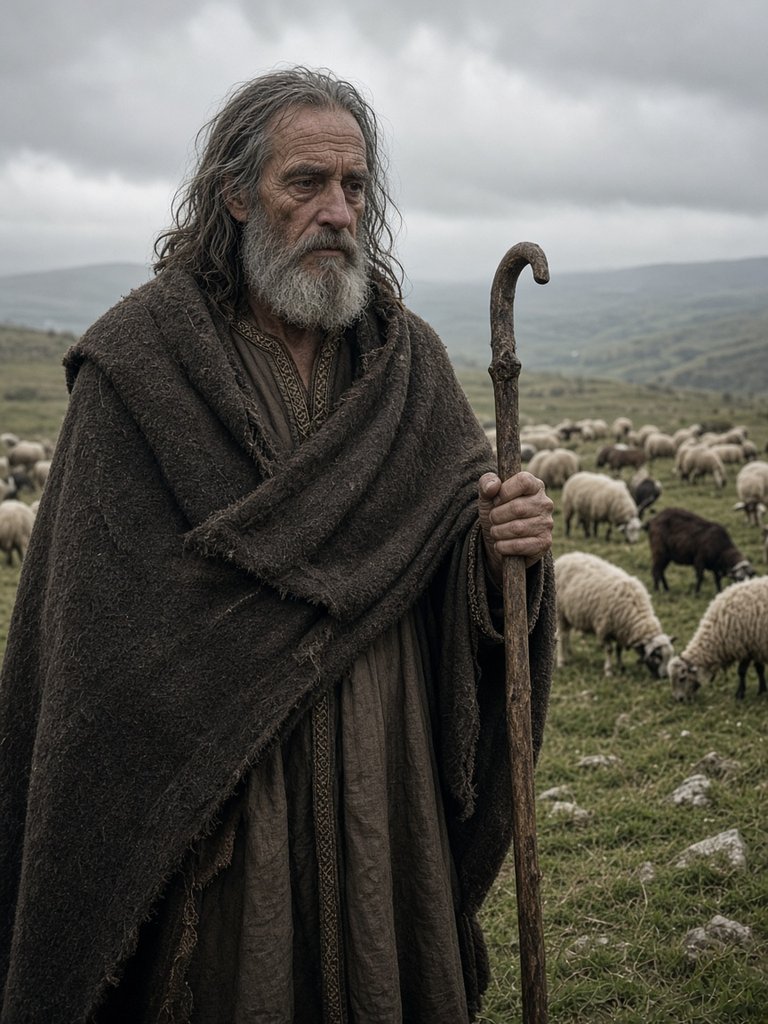
Thyestes, son of Pelops, is the brother and bitter rival of Atreus. In Homer he is simply “Thyestes, rich in flocks”, who held the sceptre of Mycenae after Atreus and passed it to Agamemnon (Iliad 2.106–108, tr. Butler). The Odyssey remembers “the foreland where Thyestes used to dwell, but where Aegisthus was then living” (Odyssey 4.517–518, tr. Butler).
Later poets tell the darker story. Thyestes seduced Aerope, the wife of Atreus, and with her help took the golden lamb that carried the kingship. Atreus drove him out, then pretended a reconciliation and served him the flesh of his own sons at a feast; when Thyestes learned what he had eaten he cursed the house of Atreus (Aeschylus, Agamemnon 1590–1602; Apollodorus, Epitome 2.10–13, paraphrased).
Seeking vengeance, he followed an oracle and fathered Aigisthos on his own daughter Pelopia. Aigisthos killed Atreus, and later Agamemnon (Apollodorus, Epitome 2.14, paraphrased). Seneca’s Thyestes made his feast a byword for horror.
Epithets
- πολύαρνι · poluarni
- rich in lambs (Iliad 2.106)
Symbols and virtues
Revenge passed down the generations. Symbols: the golden lamb, the feast.
Myths
- The sceptre. Iliad 2.106–108.
- The golden lamb and Aerope. Apollodorus, Epitome 2.10–12.
- The feast. Aeschylus, Agamemnon 1590–1602.
- Father of Aigisthos. Apollodorus, Epitome 2.14.
In the poets
“Atreus, when he died, left it to Thyestes, rich in flocks, and Thyestes in his turn left it to be borne by Agamemnon.”Homer, Iliad 2.106–107, tr. Samuel Butler (1898), public domain.
Sources
Homer, Iliad 2.100–108; Odyssey 4.517–518; Aeschylus, Agamemnon 1583–1611; Apollodorus, Epitome 2.10–14; Seneca, Thyestes.
Quotations in public-domain translations (Evelyn-White 1914, Butler 1898/1900, Taylor 1792); other authors paraphrased.