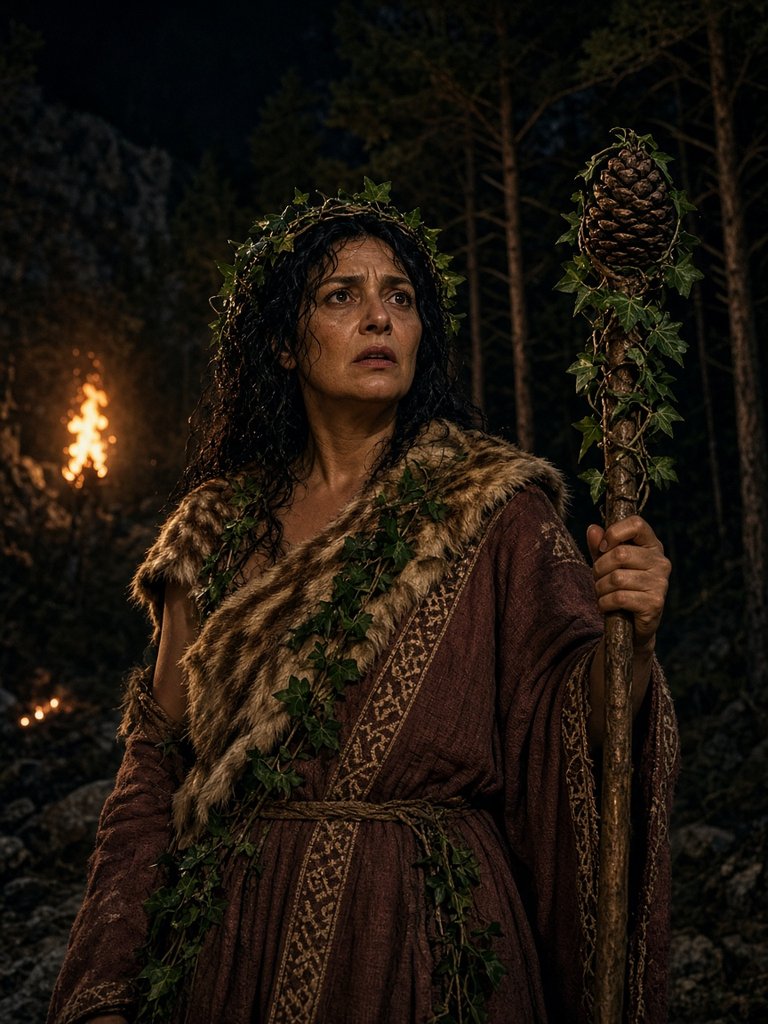
Agave is a daughter of Kadmos and Harmonia. Hesiod writes: “And Harmonia, the daughter of golden Aphrodite, bare to Cadmus Ino and Semele and fair-cheeked Agave” (Theogony 975–976, tr. Evelyn-White). She married Echion, one of the Spartoi, and was the mother of Pentheus (Apollodorus 3.4.2, paraphrased).
With her sisters she denied that Semele had borne a child to Zeus, and so Dionysos drove the women of Thebes in frenzy to Mount Kithairon. In Euripides’ Bacchae, when Pentheus came to spy on the maenads, Agave led them in tearing him apart, believing him a young lion, and carried his head back to Thebes in triumph (Bacchae 1043–1152, 1168–1215, paraphrased).
Her father slowly brought her back to her senses, and she recognized what she held (Bacchae 1216–1300, paraphrased). Dionysos sent the family into exile, and Agave went away from Thebes (Bacchae 1330–1392; Apollodorus 3.5.2, paraphrased).
Epithets
- καλλιπάρῃος · kalliparēos
- fair-cheeked (Theogony 976)
Symbols and virtues
Divine madness and terrible recognition. Symbols: the thyrsus, the fawn-skin, the ivy.
Myths
- Daughter of Kadmos and Harmonia. Theogony 975–976.
- Mother of Pentheus. Apollodorus 3.4.2.
- The death of Pentheus. Euripides, Bacchae 1043–1152.
- Recognition and exile. Euripides, Bacchae 1216–1392.
In the poets
“And Harmonia, the daughter of golden Aphrodite, bare to Cadmus Ino and Semele and fair-cheeked Agave.”Hesiod, Theogony 975–976, tr. H. G. Evelyn-White (1914), public domain.
Sources
Hesiod, Theogony 975–978; Euripides, Bacchae; Apollodorus 3.4.2, 3.5.2; Ovid, Metamorphoses 3.701–733.
Quotations in public-domain translations (Evelyn-White 1914, Butler 1898/1900, Taylor 1792); other authors paraphrased.