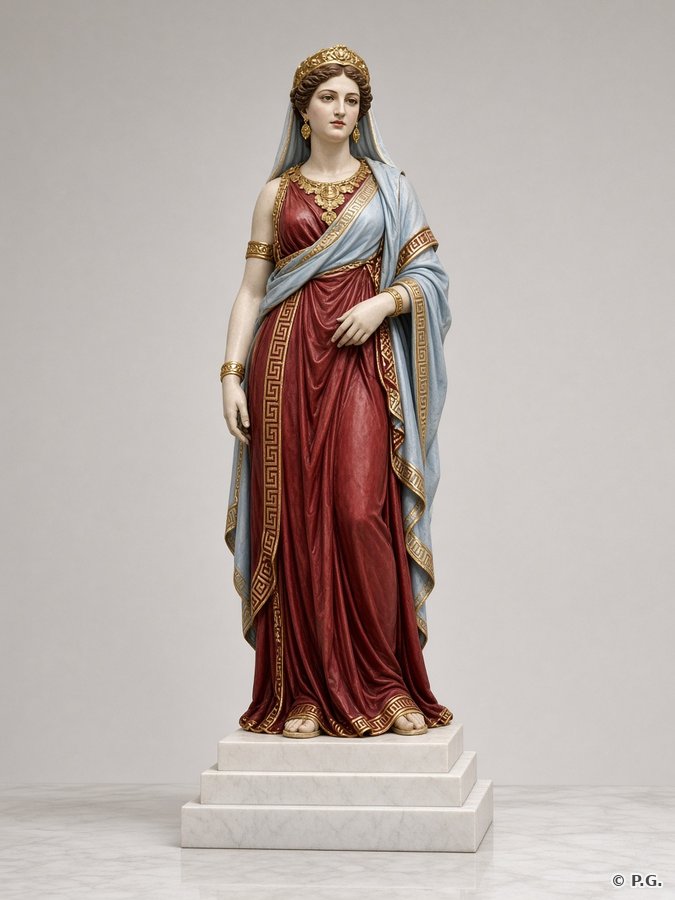
Harmonia, “the joining”, is the daughter of Aphrodite and Ares, the child of Love and War. Hesiod: “Cytherea bare to Ares the shield-piercer Panic and Fear, terrible gods … and Harmonia whom high-spirited Cadmus made his wife” (Theogony 933–937). “Harmonia, the daughter of golden Aphrodite, bare to Cadmus Ino and Semele and fair-cheeked Agave and Autonoe … and Polydorus also in rich-crowned Thebe” (Theogony 975–978).
All the gods came to the wedding of Kadmos and Harmonia at Thebes, as Pindar remembers (Pythian 3.88–95), and Kadmos gave her a robe and a necklace made by Hephaistos (Apollodoros 3.4.2). On Olympos she dances in the ring with the Charites, the Horai, Hebe and Aphrodite while Apollo plays (Homeric Hymn to Apollo 194–196). At the end Kadmos and Harmonia were changed into serpents and carried to the Isles of the Blessed (Euripides, Bacchae 1330–1339; Apollodoros 3.5.4).
Epithets
- Ἁρμονία · Harmonia
- the joining, harmony
- Κάδμου ἄλοχος · Kadmou alochos
- wife of Kadmos (Theogony 937)
Domains and symbols
Harmony: the fitting together of opposites, as she is born of Love and War; marriage and concord in the household. Admire: concord, the joining of differences. Sacred symbols: the necklace and the robe of her wedding.
Myths
- Daughter of Aphrodite and Ares. Sister of Phobos and Deimos (Theogony 933–937).
- Wedding at Thebes. The gods attended (Pindar, Pythian 3.88–95).
- The necklace. Made by Hephaistos, given by Kadmos (Apollodoros 3.4.2).
- Mother of Semele. And so grandmother of Dionysos (Theogony 975–978, 940–942).
- The dance on Olympos. With the Charites, Horai, Hebe and Aphrodite (Homeric Hymn to Apollo 194–196).
- Serpents. She and Kadmos become serpents (Euripides, Bacchae 1330–1339).
Offerings
Flowers and a cup of wine at a wedding or anniversary (modern practice).
Beneath the Divine Mind
Harmonia is the Divine Mind as the joining of opposites: the child of Love and War who makes one thing of two. The ancients saw harmony in the soul, the city and the cosmos alike. Like every god she stands beneath the One (The One and the Many).
Honouring Harmonia today
- Marriage. Name her at a wedding or anniversary.
- Concord. Reconcile two things that pull against each other in your life.
- Reading. Read the dance on Olympos (Homeric Hymn to Apollo 189–206).
Hymn
Meanwhile the rich-tressed Graces and cheerful Seasons dance with Harmonia and Hebe and Aphrodite, daughter of Zeus, holding each other by the wrist.Homeric Hymn 3, To Apollo, 194–196, tr. H. G. Evelyn-White (1914), public domain. There is no Orphic hymn to Harmonia.
Homonoia Ὁμόνοια
Concord, “being of one mind” · Roman: Concordia
Homonoia is Concord, the state of being of one mind (homo-, “same”, and noos, “mind”). She is a personified power rather than a goddess with myths, but she had altars and was invoked by cities and leagues. At Olympia Pausanias saw her altar among the altars of the Altis, listed next to an altar of Athena and the altar of the Mother of the gods (Pausanias 5.14.9).
The philosophers gave her a precise meaning. Aristotle defines concord as “political friendship”: citizens are of one mind when they agree about what is to their interest, choose the same things and act on what they have resolved together (Nicomachean Ethics 9.6, 1167a22–b4). Rome honoured the same power as Concordia, with a temple below the Capitol.
Epithets: Ὁμόνοια · Homonoia (concord, one-mindedness)
Domains and symbols: Concord among citizens, friends and households. Admire: agreement, reconciliation, peace kept by common purpose. Sacred symbols: the libation bowl (phiale), joined right hands, the cornucopia of later art.
Myths:
- Her altar at Olympia. Among the altars of the Altis (Pausanias 5.14.9).
- Political friendship. Aristotle’s definition of concord (Nicomachean Ethics 9.6).
Cult sites:
- Olympia. An altar of Homonoia in the Altis (Pausanias 5.14.9).
Offerings: A shared cup or meal after a reconciliation; incense at the household altar (modern practice).
Sources: Pausanias 5.14.9; Aristotle, Nicomachean Ethics 9.6 (1167a22–b4). Ancient sources are cited by book and line or section in the standard numbering. Quotations from Hesiod and the Homeric Hymns are in the translation of H. G. Evelyn-White (1914), from the Orphic Hymns in that of Thomas Taylor (1792), both public domain. Hemera gives each day's god in brief; this page is the temple's fuller account.
Sources
Hesiod, Theogony 933–937, 940–942, 975–978; Homeric Hymn 3 (to Apollo) 194–196; Pindar, Pythian 3.88–95; Euripides, Bacchae 1330–1339; Apollodoros, Library 3.4.2, 3.5.4.
Quotations in public-domain translations (Evelyn-White 1914, Butler 1898/1900, Taylor 1792); other authors paraphrased.