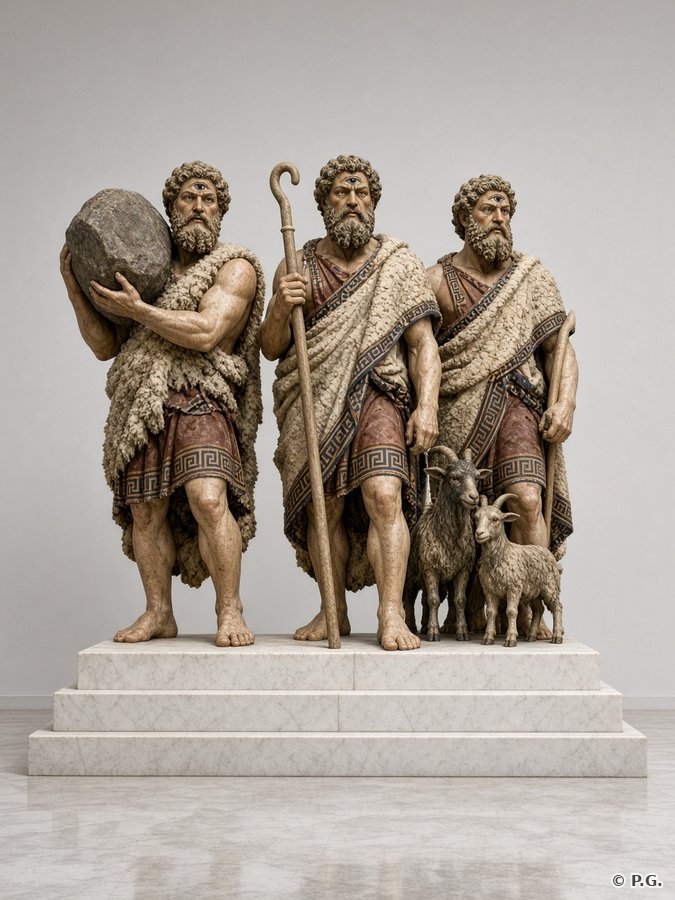
The Cyclopes of Hesiod are gods, sons of Ouranos and Gaia: “And again, she bare the Cyclopes, overbearing in spirit, Brontes, and Steropes and stubborn-hearted Arges, who gave Zeus the thunder and made the thunderbolt: in all else they were like the gods, but one eye only was set in the midst of their fore-heads. And they were surnamed Cyclopes (Orb-eyed) because one orbed eye was set in their foreheads. Strength and might and craft were in their works” (Theogony 139–146). Their names are Thunder, Lightning and Brightness.
Ouranos hid his children in the earth; Zeus freed them: “he set free from their deadly bonds the brothers of his father, sons of Heaven whom his father in his foolishness had bound. And they remembered to be grateful to him for his kindness, and gave him thunder and the glowing thunderbolt and lightening: for before that, huge Earth had hidden these. In them he trusts and rules over mortals and immortals” (Theogony 501–506). Apollodorus adds that they made the helmet of Hades and the trident of Poseidon (Library 1.2.1). Callimachus shows them at their forge on Lipara making the bow and arrows of the young Artemis (Hymn 3.46–86), and in Euripides Apollo kills them in revenge for the death of Asklepios by the thunderbolt (Alcestis 3–7). The Cyclopes of the Odyssey are another people: “the lawless and inhuman Cyclopes”, who “have no laws nor assemblies of the people, but live in caves on the tops of high mountains” (Odyssey 9.106–115, tr. Butler).
Epithets
- Βρόντης · Brontes
- the Thunderer
- Στερόπης · Steropes
- the Lightener
- Ἄργης · Arges
- the Bright, the Vivid
- Ὑπέρβιον ἦτορ ἔχοντες · Hyperbion etor echontes
- “overbearing in spirit” (Theogony 139)
Domains and symbols
Thunder, lightning and the craft of the forge: the power behind Zeus’ rule. Admire: strength joined to skill, gratitude repaid. Sacred symbols: the single round eye, the hammer and anvil, the thunderbolt, Cyclopean walls.
Myths
- Born of Heaven and Earth. Theogony 139–146.
- Freed by Zeus. They give him the thunderbolt in gratitude (Theogony 501–506; Apollodorus 1.2.1).
- Gifts to the brothers. The helmet of Hades and the trident of Poseidon (Apollodorus 1.2.1).
- The bow of Artemis. Forged on Lipara (Callimachus, Hymn 3.46–86).
- Killed by Apollo. In revenge for Asklepios (Euripides, Alcestis 3–7).
- The builders. The walls of Tiryns were said to be their work (Pausanias 2.25.8).
Cult sites
- Isthmus of Corinth. An ancient sanctuary called the altar of the Cyclopes, where sacrifice was offered to them (Pausanias 2.2.1).
Offerings
Pausanias records sacrifice to the Cyclopes at their altar on the Isthmus (2.2.1). Today: honour them in good work done with the hands, and at a storm with thunder.
Beneath the Divine Mind
The Cyclopes are the Divine Mind as power with craft: thunder and lightning made and given, so that Zeus may rule by right and not by force alone. Their gift repays kindness. Like every god they stands beneath the One (The One and the Many).
Honouring the Cyclopes today
- Craft. Do a piece of careful work with your hands.
- Gratitude. Repay a kindness, as they repaid Zeus.
- Thunder. At thunder, remember the three smiths and the justice of Zeus.
Sources
Hesiod, Theogony 139–146, 501–506; Apollodorus, Library 1.1.2, 1.2.1, 3.10.4; Callimachus, Hymn 3 (to Artemis) 46–86; Euripides, Alcestis 1–7; Pausanias 2.2.1, 2.25.8; Homer, Odyssey 9.106–115. Quotations from Homer are in the prose translation of Samuel Butler (Odyssey 1900), public domain, which gives the gods their Latin names (Jove, Neptune).
Quotations in public-domain translations (Evelyn-White 1914, Butler 1898/1900, Taylor 1792); other authors paraphrased.