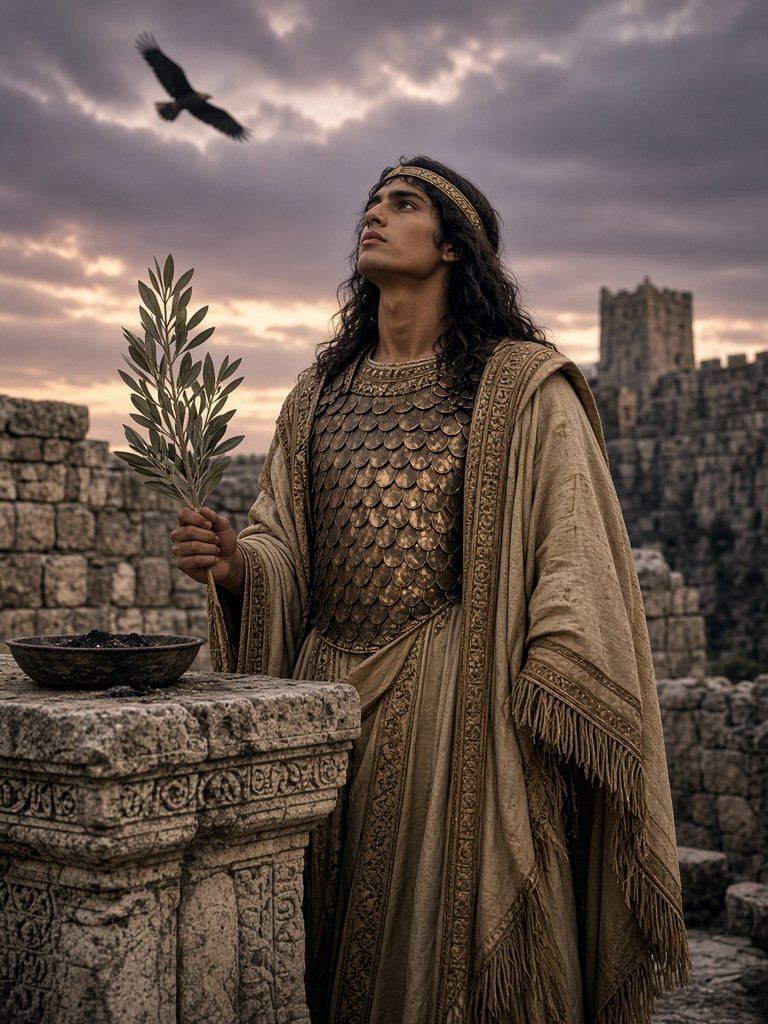
Helenos, son of Priam and Hekabe, is the seer of the Trojans as Kalchas is of the Achaeans. When the Trojans are about to break, “Priam’s son Helenus, wisest of augurs, said to Hector and Aeneas, ‘Hector and Aeneas, you two are the mainstays of the Trojans and Lycians’” (Iliad 6.76–78, tr. Butler), and sends Hektor into the city to have the women pray to Athena (Iliad 6.86–101, paraphrased).
He hears the will of the gods and urges Hektor to challenge the best of the Achaeans to single combat (Iliad 7.44–53, paraphrased). Later, captured by Odysseus, he revealed that Troy could not be taken without the bow of Philoktetes (Sophocles, Philoctetes 604–613, paraphrased).
After the war he went with Neoptolemos to Epirus, and after Neoptolemos’ death he married Andromache and ruled there, where Virgil’s Aeneas finds him in a little copy of Troy (Aeneid 3.294–505, paraphrased).
Epithets
- Πριαμίδης · Priamidēs
- son of Priam
- οἰωνοπόλων ὄχ᾽ ἄριστος · oiōnopolōn och’ aristos
- best of augurs (Iliad 6.76)
Symbols and virtues
Prophecy and survival. Symbols: the laurel branch, the bird of omen, the altar.
Myths
- Advice to Hektor. Iliad 6.73–101.
- The challenge. Iliad 7.44–53.
- The oracle of the bow. Sophocles, Philoctetes 604–613.
- King in Epirus. Aeneid 3.294–505.
In the poets
“Priam’s son Helenus, wisest of augurs, said to Hector and Aeneas, ‘Hector and Aeneas, you two are the mainstays of the Trojans and Lycians.’”Homer, Iliad 6.76–78, tr. Samuel Butler (1898), public domain.
Sources
Homer, Iliad 6.73–101, 7.44–53, 13.576–600; Sophocles, Philoctetes 604–613; Virgil, Aeneid 3.294–505.
Quotations in public-domain translations (Evelyn-White 1914, Butler 1898/1900, Taylor 1792); other authors paraphrased.