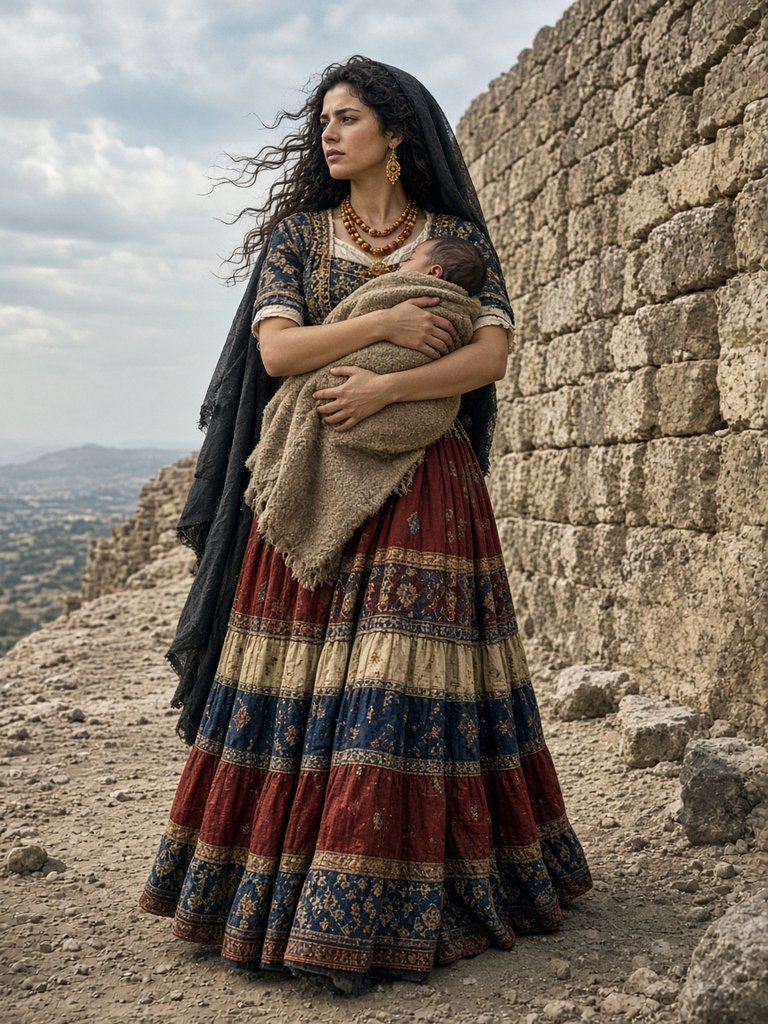
Andromache, daughter of Eetion king of Thebe under Mount Plakos, is the wife of Hektor and mother of Astyanax. Achilles had sacked her city and killed her father and seven brothers, and she says to Hektor on the walls of Troy: “Nay—Hector—you who to me are father, mother, brother, and dear husband—have mercy upon me; stay here upon this wall; make not your child fatherless, and your wife a widow” (Iliad 6.429–432, tr. Butler).
Hektor answers that he must fight, and that he knows Troy will fall and she will be led away as a slave (Iliad 6.441–465). When she hears the wailing from the walls and sees him dragged behind Achilles’ chariot, she faints and throws from her head the headdress Aphrodite gave her on her wedding day (Iliad 22.437–472, paraphrased), and her lament leads the mourning over his body at the end of the poem (Iliad 24.723–745).
After the fall of Troy her son was thrown from the walls and she was given as a prize to Neoptolemos, son of Achilles; Euripides’ Trojan Women and Andromache tell of her captivity in Thessaly and at Phthia, and of the son she bore there, Molossos, ancestor of the kings of Epeiros (Euripides, Andromache 1243–1252; Pausanias 1.11.1, paraphrased). Virgil finds her at last at Bouthroton in Epeiros, married to Hektor’s brother Helenos (Aeneid 3.294–505, paraphrased). Pausanias records a hero-shrine of Andromache at Pergamon (1.11.2, paraphrased).
Epithets
- λευκώλενος · leukōlenos
- white-armed (Iliad 6.371)
- ἄλοχος πολύδωρος · alochos poludōros
- richly dowered wife (Iliad 6.394)
Symbols and virtues
Love, fidelity and the grief of the war-widow. Symbols: the child Astyanax, the wedding headdress, the loom she returns to, the walls of Troy.
Myths
- Daughter of Eetion. Iliad 6.395–428.
- Farewell on the walls. Iliad 6.390–502.
- The headdress thrown down. Iliad 22.437–472.
- Lament for Hektor. Iliad 24.723–745.
- Captivity. Euripides, Trojan Women, Andromache.
- Bouthroton. Virgil, Aeneid 3.294–505.
Cult and places
- Pergamon. Hero-shrine (Pausanias 1.11.2).
In the poets
“Nay—Hector—you who to me are father, mother, brother, and dear husband—have mercy upon me; stay here upon this wall; make not your child fatherless, and your wife a widow.”Homer, Iliad 6.429–432, tr. Samuel Butler (1898), public domain.
Sources
Homer, Iliad 6.369–502, 22.437–515, 24.723–745; Euripides, Trojan Women, Andromache; Virgil, Aeneid 3.294–505; Pausanias 1.11.1–2.
Quotations in public-domain translations (Evelyn-White 1914, Butler 1898/1900, Taylor 1792); other authors paraphrased.