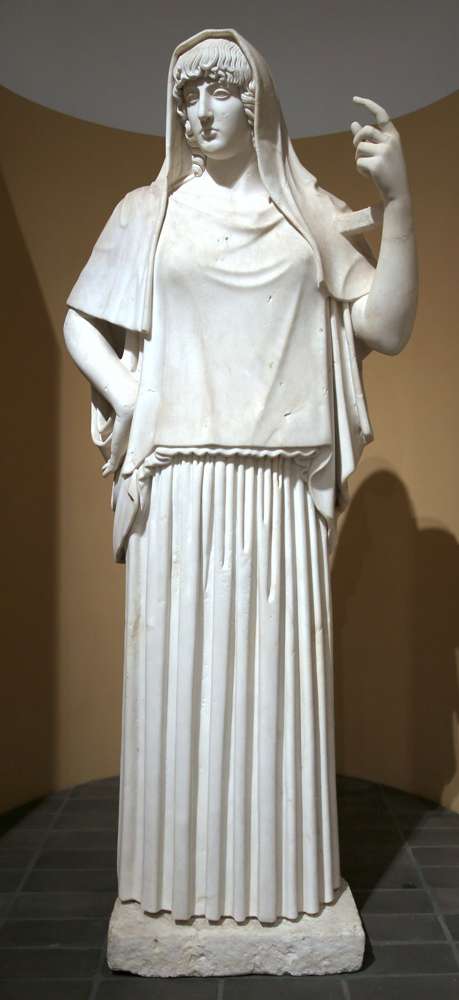
Sailko, CC BY 3.0, via Wikimedia Commons

Hestia, eldest child of Kronos and Rhea, is the goddess of the hearth (Hesiod, Theogony 453–454). First swallowed by her father and last given back, she is honoured first and last at every rite. When Poseidon and Apollo sought her, she swore to remain a maiden for ever, and Zeus gave her a place in the middle of the house and the first portion of every sacrifice (Homeric Hymn to Aphrodite 21–32). Our Temple keeps the later canon of the Twelve, in which Dionysos takes the seat she yields; she never leaves the house.
Epithets
- Πρυτανεία · Prytaneia
- of the prytaneion, the town hall where the city’s common hearth burned
- Βουλαία · Boulaia
- of the Council, whose altar stood in the Athenian council house (Xenophon, Hellenica 2.3.52)
- Παρθένος · Parthenos
- the maiden, sworn to virginity (Homeric Hymn to Aphrodite 26–28)
Domains and symbols
The hearth and its fire; the household and the city as one family; hospitality; the first and last share of every offering. Admire: steadiness, reverence, a well-kept home. Sacred symbols: the flame, the hearth, the veil.
Myths
- First and last. Kronos swallowed her first of his children and gave her back last, so she is both eldest and youngest (Theogony 453–497; Homeric Hymn to Aphrodite 22–23).
- Her oath. Courted by Poseidon and Apollo, she touched the head of Zeus and swore to stay a maiden; in place of marriage Zeus gave her honour in every house and every temple of the gods (Homeric Hymn to Aphrodite 24–32).
- She stays at home. When the gods ride out across the heavens, “Hestia alone abides in the house of the gods” (Plato, Phaedrus 247a).
Cult sites
- The Prytaneion of Athens. The common hearth of the city, beside which stood statues of Eirene and Hestia (Pausanias 1.18.3). Colonists carried fire from the mother city’s hearth to light the hearth of the new city (Herodotus 1.146).
- Olympia. In the prytaneion a hearth of ash burned day and night, and from it ash was carried to the great altar of Zeus (Pausanias 5.15.8–9).
- Delphi. Hestia tends the holy house of Apollo at Pytho (Homeric Hymn 24); an undying fire was kept there (Plutarch, Numa 9).
Festivals
- Every sacrifice. The Greeks began with Hestia: “from Hestia first” became a proverb for beginning well (Plato, Cratylus 401b–d; Aristophanes, Wasps 846).
- Amphidromia. A few days after a birth the newborn was carried round the hearth and so received into the house.
Offerings
The first and the last libation of every rite are hers: “without you mortals hold no banquet, where one does not duly pour sweet wine in offering to Hestia both first and last” (Homeric Hymn 29.4–6). Today: light a lamp or candle before any other prayer; pour a little oil or wine; keep the hearth, or its stand-in, clean.
Beneath the Divine Mind
Hestia is the Divine Mind as stillness and centre: the point that stays fixed while everything turns about it, personified and deified as the fire at the heart of the house. Like every god she stands beneath the One, as set out on The One and the Many. She still acts wherever a household gathers at one table and a flame is lit before prayer.
Honouring Hestia today
- Altar. A lamp or candle, kept clean and lit first.
- Offerings. Olive oil, wine, bread and the first portion of a meal.
- Order of rite. Begin and end every rite with Hestia.
- Hymn. Recite Homeric Hymn 24 or 29.
Hymn
Hestia, in the high dwellings of all, both deathless gods and men who walk on earth, you have gained an everlasting abode and highest honour: glorious is your portion and your right. For without you mortals hold no banquet,—where one does not duly pour sweet wine in offering to Hestia both first and last.Homeric Hymn 29, To Hestia, 1–6. Homeric Hymns, tr. H. G. Evelyn-White (1914), public domain.
Sources
Hesiod, Theogony 453–497; Homeric Hymn to Aphrodite 21–32; Homeric Hymns 24 and 29; Plato, Phaedrus 247a and Cratylus 401b–d; Aristophanes, Wasps 846; Xenophon, Hellenica 2.3.52; Herodotus 1.146; Pausanias 1.18.3 and 5.15.8–9; Plutarch, Numa 9.
Quotations in public-domain translations (Evelyn-White 1914, Butler 1898/1900, Taylor 1792); other authors paraphrased.