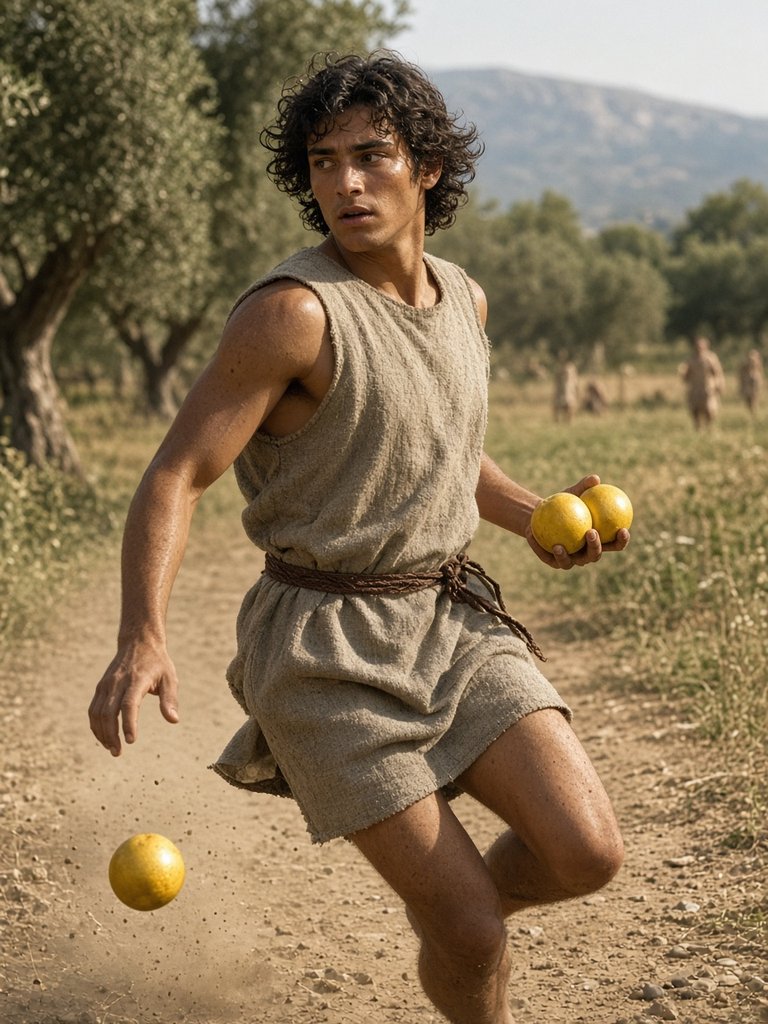
Hippomenes, son of Megareus of Onchestos, was the suitor who won the swift huntress Atalanta; some writers give the winner as Melanion (Ovid, Metamorphoses 10.560–608; Apollodorus 3.9.2, paraphrased). Atalanta would marry only the man who could outrun her, and those who lost were put to death.
Hippomenes prayed to Aphrodite, who gave him three golden apples. During the race he threw them one by one; each time Atalanta stopped to pick up the shining fruit, and he won the race and her hand (Ovid, Metamorphoses 10.609–680; Apollodorus 3.9.2, paraphrased).
He forgot to give thanks to the goddess. In her anger she filled the pair with desire in a holy place, a shrine of the Mother of the gods in Ovid, a precinct of Zeus in Apollodorus, and as punishment they were turned into lions (Ovid, Metamorphoses 10.681–707; Apollodorus 3.9.2, paraphrased).
Epithets
- Ἱππομένης · Hippomenēs
- strong as a horse
Symbols and virtues
Love won by guile and a gift, and gratitude forgotten. Symbols: the golden apples, the race-course, the lions.
Myths
- Suitor of Atalanta. Ovid, Metamorphoses 10.560–608.
- The golden apples. Ovid, Metamorphoses 10.609–680; Apollodorus 3.9.2.
- Turned into lions. Ovid, Metamorphoses 10.681–707; Apollodorus 3.9.2.
Sources
Theocritus 3.40–42; Apollodorus 3.9.2; Ovid, Metamorphoses 10.560–707; Hyginus, Fabulae 185.
Quotations in public-domain translations (Evelyn-White 1914, Butler 1898/1900, Taylor 1792); other authors paraphrased.