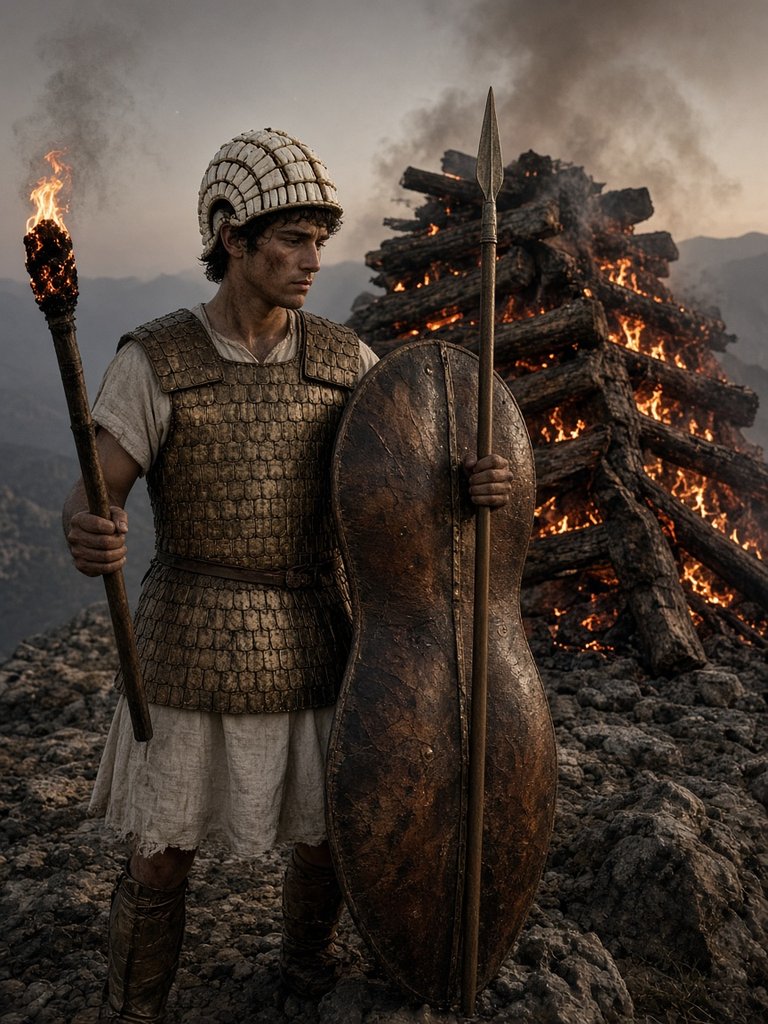
Hyllos was the eldest son of Herakles and Deianeira. In Sophocles’ Women of Trachis he brings his mother the news of his father’s agony in the poisoned robe and bitterly reproaches her, learning too late that she had been deceived by the centaur Nessos (Women of Trachis 734–820, 932–942, paraphrased).
The dying Herakles made him swear to carry him to the summit of Mount Oita and build his pyre, and to marry Iole; Hyllos obeyed, though he would not light the pyre himself (Women of Trachis 1157–1278; Apollodorus 2.7.7, paraphrased).
After Herakles’ death he led the hero’s sons, the Herakleidai, and with Iolaos and the Athenians defeated Eurystheus; Apollodorus says he killed the king himself (2.8.1, paraphrased). Trying to return to the Peloponnese, he was killed in single combat at the Isthmos by Echemos of Tegea (Herodotus 9.26; Pausanias 8.5.1, paraphrased). The Dorian tribe of the Hylleis took its name from him.
Epithets
- Ἡρακλείδης · Hērakleidēs
- son of Herakles
Symbols and virtues
Filial duty in grief, and a people’s claim to return. Symbols: the pyre on Oita, the spear.
Myths
- News of the poisoned robe. Sophocles, Women of Trachis 734–820.
- The pyre on Mount Oita. Sophocles, Women of Trachis 1157–1278.
- Defeat of Eurystheus. Apollodorus 2.8.1.
- Death at the Isthmos. Herodotus 9.26; Pausanias 8.5.1.
Sources
Sophocles, Women of Trachis; Euripides, Children of Heracles; Herodotus 9.26; Apollodorus 2.7.7, 2.8.1–2; Pausanias 1.35.8, 8.5.1.
Quotations in public-domain translations (Evelyn-White 1914, Butler 1898/1900, Taylor 1792); other authors paraphrased.