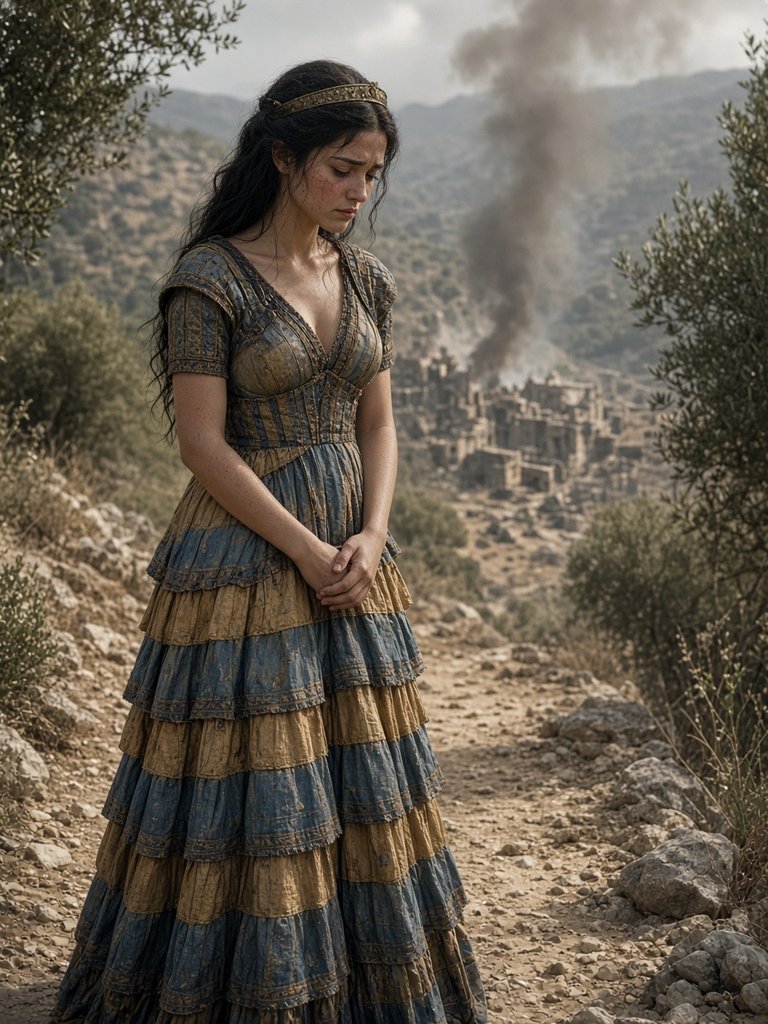
Iole was the daughter of Eurytos, the archer-king of Oichalia, and sister of Iphitos. Eurytos offered her as a prize to anyone who could beat him and his sons at archery; Herakles won, but Eurytos refused to give her up, fearing that Herakles might again go mad and kill his children (Apollodorus 2.6.1, paraphrased).
Years later Herakles marched on Oichalia, sacked it, killed Eurytos and his sons, and carried Iole away as a captive (Apollodorus 2.7.7, paraphrased). In Sophocles’ Women of Trachis she arrives at Trachis among the captive women, silent, and Deianeira learns that it was love for her that drove Herakles to destroy the city (Trachiniae 225–496, paraphrased).
Fearing to lose her husband, Deianeira sent him the robe smeared with the Centaur’s poisoned blood, which killed him. As he lay dying, Herakles made his son Hyllos swear to marry Iole (Trachiniae 531–813, 1216–1251; Apollodorus 2.7.7, paraphrased).
Epithets
- Εὐρυτίς · Eurytis
- daughter of Eurytos
Symbols and virtues
The silent captive whose presence brings destruction. Symbols: the archery prize, the captive’s veil.
Myths
- The archery contest. Apollodorus 2.6.1.
- The sack of Oichalia. Apollodorus 2.7.7.
- The captive at Trachis. Sophocles, Trachiniae 225–496.
- Promised to Hyllos. Sophocles, Trachiniae 1216–1251.
Sources
Sophocles, Trachiniae; Apollodorus 2.6.1, 2.7.7; Diodorus 4.31.1–2, 4.37.5; Ovid, Metamorphoses 9.136–151.
Quotations in public-domain translations (Evelyn-White 1914, Butler 1898/1900, Taylor 1792); other authors paraphrased.