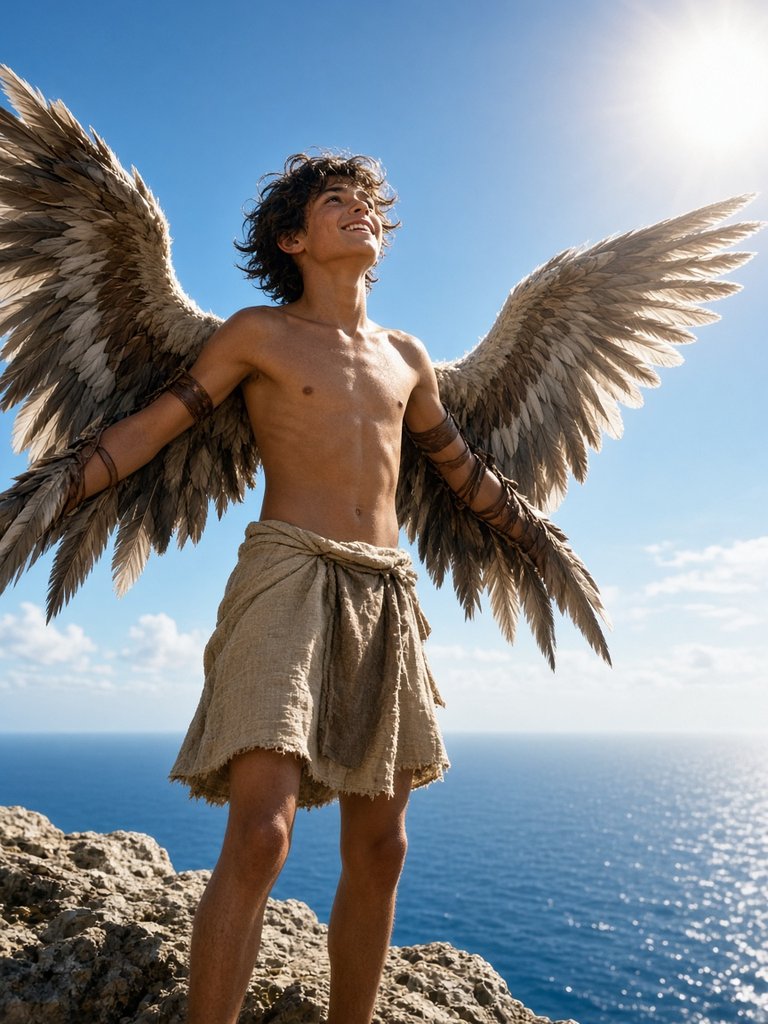
Ikaros is the son of Daidalos by a slave woman of Minos called Naukrate (Apollodorus, Epitome 1.12, paraphrased). When Minos shut father and son in the Labyrinth, or in Crete, Daidalos made wings of feathers held with wax so that they could escape through the air.
Daidalos warned his son to fly neither too high, where the sun would melt the wax, nor too low, where the sea would soak the feathers. Ikaros, delighting in flight, soared upward; the wax melted and he fell into the sea, which was named the Ikarian Sea after him (Apollodorus, Epitome 1.12–13; Ovid, Metamorphoses 8.183–235, paraphrased).
His body was washed ashore on the island later called Ikaria, and Herakles was said to have buried it (Apollodorus 2.6.3, paraphrased). Pausanias records a rationalized version in which father and son escaped by boat under sail, and Ikaros was drowned when his boat overturned (Pausanias 9.11.4–5, paraphrased).
Epithets
- Ἴκαρος · Ikaros
- Icarus
Symbols and virtues
Youthful daring and the cost of ignoring a limit. Symbols: the wings, the melting wax, the sea.
Myths
- The flight from Crete. Apollodorus, Epitome 1.12; Ovid, Metamorphoses 8.183–235.
- The fall into the Ikarian Sea. Apollodorus, Epitome 1.13.
- Buried by Herakles on Ikaria. Apollodorus 2.6.3.
- The rationalized version. Pausanias 9.11.4–5.
Sources
Apollodorus 2.6.3, Epitome 1.12–13; Diodorus 4.77; Pausanias 9.11.4–5; Ovid, Metamorphoses 8.183–235.
Quotations in public-domain translations (Evelyn-White 1914, Butler 1898/1900, Taylor 1792); other authors paraphrased.