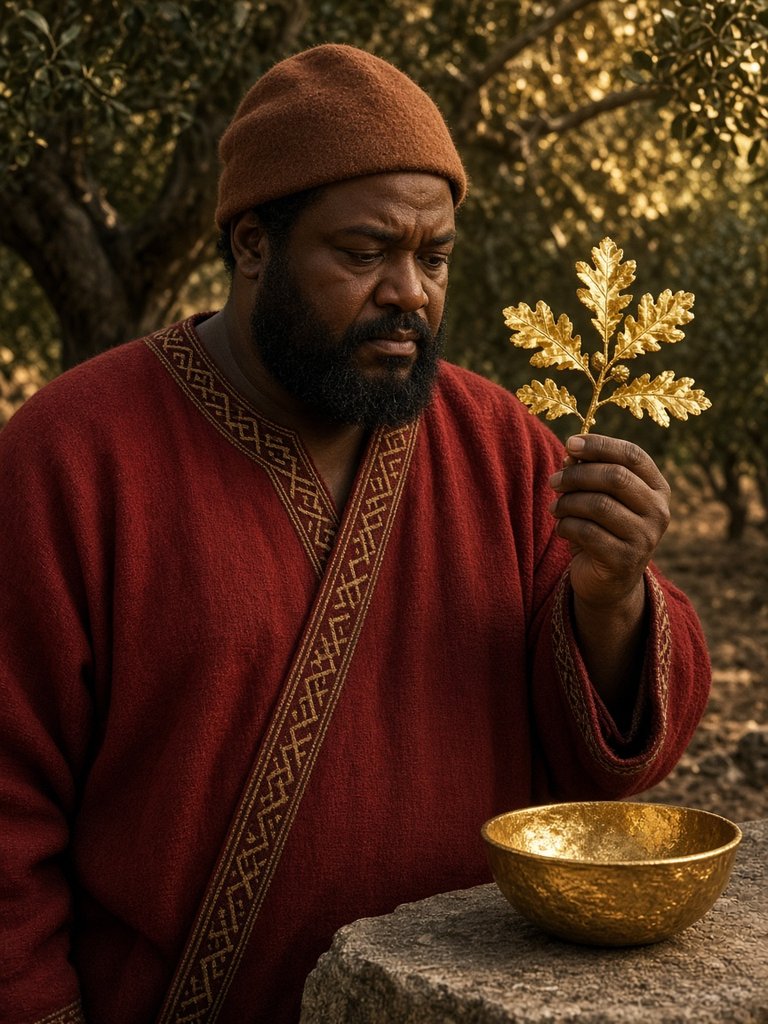
Midas, son of Gordios, was a king of Phrygia, famous for his wealth. Herodotus says he was the first foreigner to dedicate an offering at Delphi, his royal throne (1.14), and he mentions the gardens of Midas in Macedonia, where roses grow wild and where Silenos was said to have been caught (8.138, paraphrased).
When Silenos, the companion of Dionysos, strayed and was brought to Midas, the king treated him kindly and returned him. Dionysos offered a reward, and Midas asked that everything he touched should turn to gold. Even his food and drink turned to metal, and he begged to be released; the god told him to wash in the river Paktolos, whose sands have carried gold ever since (Ovid, Metamorphoses 11.85–145, paraphrased).
Later he judged a contest of music between Pan and Apollo and preferred Pan; Apollo gave him the ears of an ass. He hid them under a cap, but his barber whispered the secret into a hole in the ground, and the reeds that grew there repeated it (Ovid, Metamorphoses 11.146–193, paraphrased). The legend may preserve the memory of Mita, a historical king of Phrygia.
Epithets
- Μίδας · Midas
- king of Phrygia
Symbols and virtues
Wealth that cannot feed, and foolish judgment exposed. Symbols: the golden touch, the river Paktolos, the ass’s ears.
Myths
- Throne dedicated at Delphi. Herodotus 1.14.
- Silenos in the rose gardens. Herodotus 8.138; Ovid, Metamorphoses 11.85–99.
- The golden touch and the Paktolos. Ovid, Metamorphoses 11.100–145.
- The ass’s ears. Ovid, Metamorphoses 11.146–193.
Sources
Herodotus 1.14, 8.138; Xenophon, Anabasis 1.2.13; Ovid, Metamorphoses 11.85–193.
Quotations in public-domain translations (Evelyn-White 1914, Butler 1898/1900, Taylor 1792); other authors paraphrased.