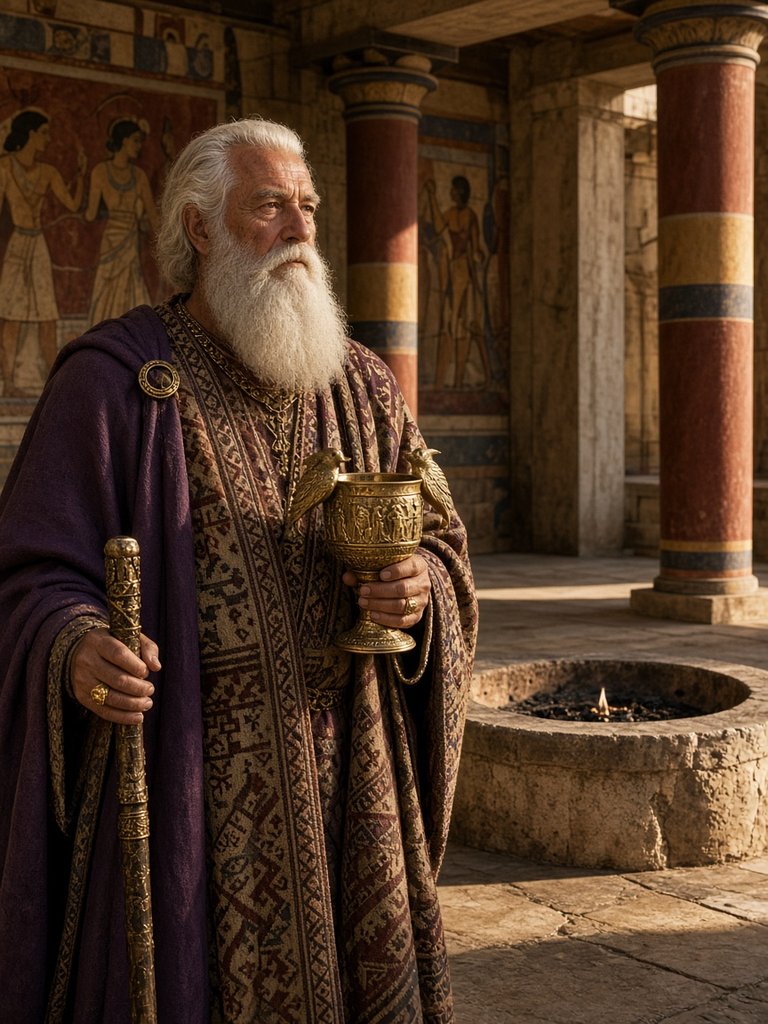
Nestor, son of Neleus, is king of Pylos and the oldest of the Achaean leaders at Troy. When Achilles and Agamemnon quarrel, “uprose smooth-tongued Nestor, the facile speaker of the Pylians, and the words fell from his lips sweeter than honey” (Iliad 1.247–249, tr. Butler). Two generations had passed away under his rule and he was reigning over the third (Iliad 1.250–252). He tells how, when Herakles sacked Pylos, he alone of the twelve sons of Neleus survived (Iliad 11.690–693, paraphrased).
In his tent he keeps a famous cup brought from home, which “had four handles, on each of which there were two golden doves feeding” (Iliad 11.633–635, tr. Butler). His counsel is always to remember the old deeds; his son Antilochos falls at Troy. Home again, he receives Telemachos at Pylos while his people sacrifice black bulls to Poseidon on the shore, and sends him on to Sparta with his son Peisistratos (Odyssey 3.1–68, 3.474–497, paraphrased).
Pausanias saw at Pylos the house of Nestor and the cave where Neleus kept his cattle (4.36.1–2, paraphrased). The Late Bronze Age palace excavated by Carl Blegen at Ano Englianos from 1939, with its archive of Linear B tablets, is known as the Palace of Nestor.
Epithets
- Γερήνιος ἱππότα · Gerēnios hippota
- the Gerenian horseman (Iliad 2.336)
- ἡδυεπής · hēduepēs
- sweet of speech (Iliad 1.248)
- Νηλήϊος · Nēlēïos
- son of Neleus
Symbols and virtues
Age, memory and wise counsel; the host who welcomes the stranger. Symbols: the cup with golden doves, the chariot, the sacrifice on the shore.
Myths
- The sole survivor. Iliad 11.690–693.
- Peacemaker. Iliad 1.247–284.
- The cup of doves. Iliad 11.632–637.
- Telemachos at Pylos. Odyssey 3.
Cult and places
- Pylos. House of Nestor and the cave of Neleus’ cattle (Pausanias 4.36.1–2).
In the poets
“Then uprose smooth-tongued Nestor, the facile speaker of the Pylians, and the words fell from his lips sweeter than honey.”Homer, Iliad 1.247–249, tr. Samuel Butler (1898), public domain.
Sources
Homer, Iliad 1.247–284, 2.336–368, 11.632–803; Odyssey 3; Pausanias 4.36.1–2.
Quotations in public-domain translations (Evelyn-White 1914, Butler 1898/1900, Taylor 1792); other authors paraphrased.