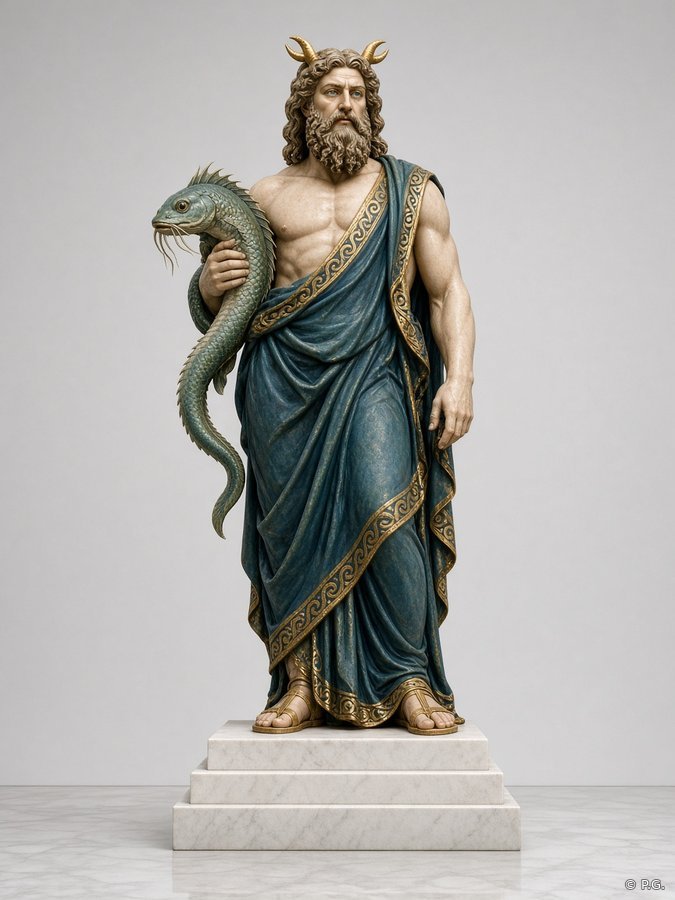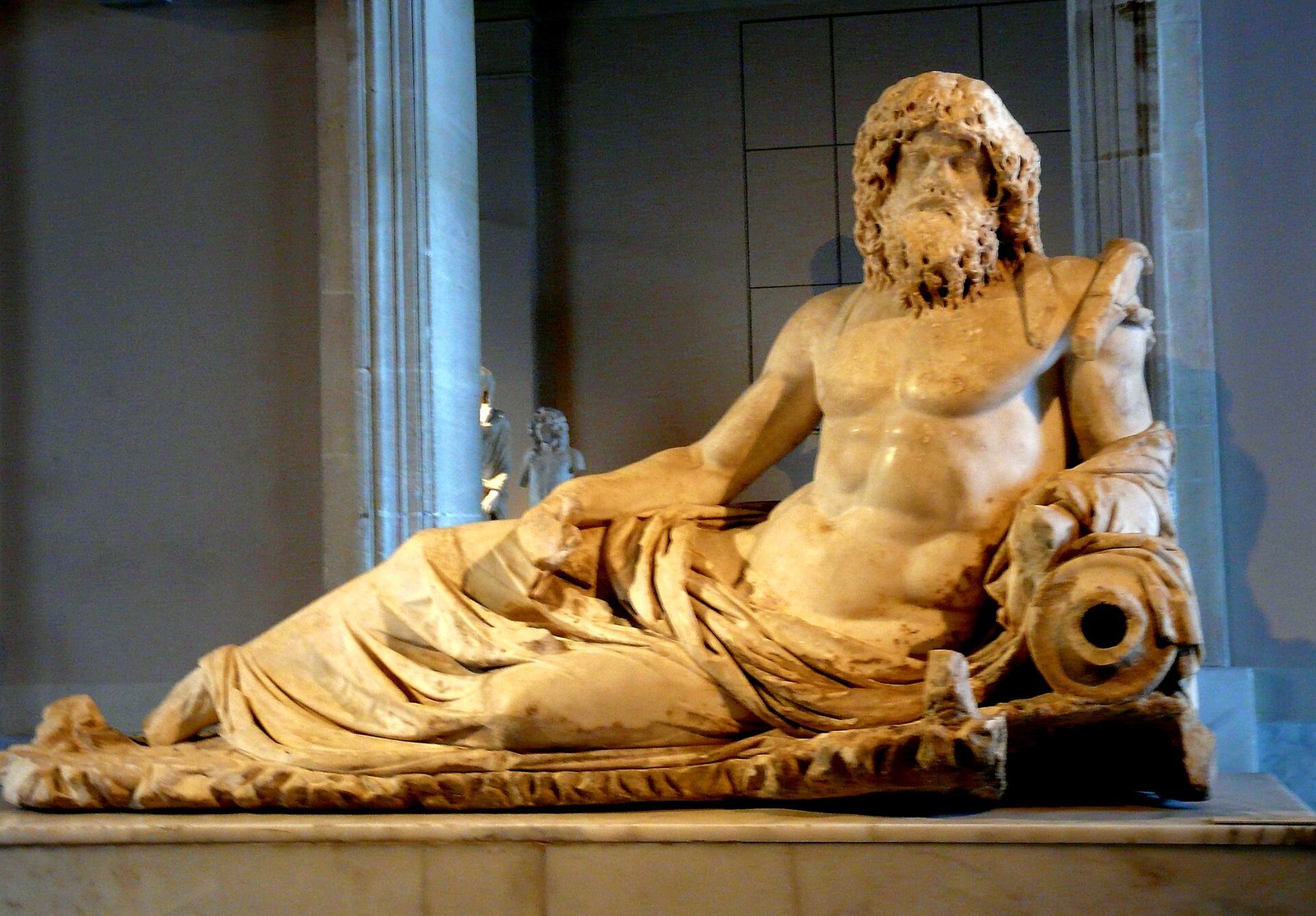
Okeanos, eldest of the Titans, son of Ouranos and Gaia (Theogony 133), is the deep-swirling river that circles the earth. With Tethys he fathered the rivers and three thousand daughters, the Okeanids (Theogony 337–370). Homer calls him “Okeanos, from whom the gods are sprung” and “from whom all are sprung” (Iliad 14.201, 14.246). On the shield of Achilles he runs round the outer rim (Iliad 18.607–608). A tenth of his water is the Styx, by which the gods swear (Theogony 785–792).
Epithets
- Βαθυδίνης · Bathydines
- deep-swirling (Theogony 133)
- Ἀψόρροος · Apsorroos
- flowing back upon himself (Iliad 18.399)
Domains and symbols
The flowing source of all waters; the boundary of the world; the beginning of the gods. Admire: generosity that gives without end. Sacred symbols: the river, the fish, the crab claws on his brow in Roman art.
Myths
- Father of rivers. Neilos, Alpheios, Eridanos, Strymon and the rest, and the Okeanids (Theogony 337–370).
- The source. “Okeanos, from whom the gods are sprung, and mother Tethys” (Iliad 14.201).
- Flux. Plato read Homer’s Okeanos and Tethys as a teaching that all things flow (Theaetetus 152e).
Cult sites
- At the edge of the world. Alexander poured libations to Okeanos at the mouth of the Indus (Arrian, Anabasis 6.19.5).
Offerings
Water poured from a cup; aromatics. Today: offer fresh water and pray for safe journeys over sea.
Beneath the Divine Mind
Okeanos is the Divine Mind as source: the ever-flowing origin from which the gods come forth, personified and deified as the world-river. Like every god he stands beneath the One (The One and the Many).
Honouring Okeanos today
- Offerings. Pour fresh water.
- Hymn. Recite the Orphic hymn below.
Hymn
Okeanos I call, whose nature ever flows, from whom at first both Gods and men arose; sire incorruptible, whose waves surround, and earth’s concluding mighty circle bound.Orphic Hymn 83, To Okeanos, 1–4. Tr. Thomas Taylor (1792), public domain; divine names as given on Hemera.
Images
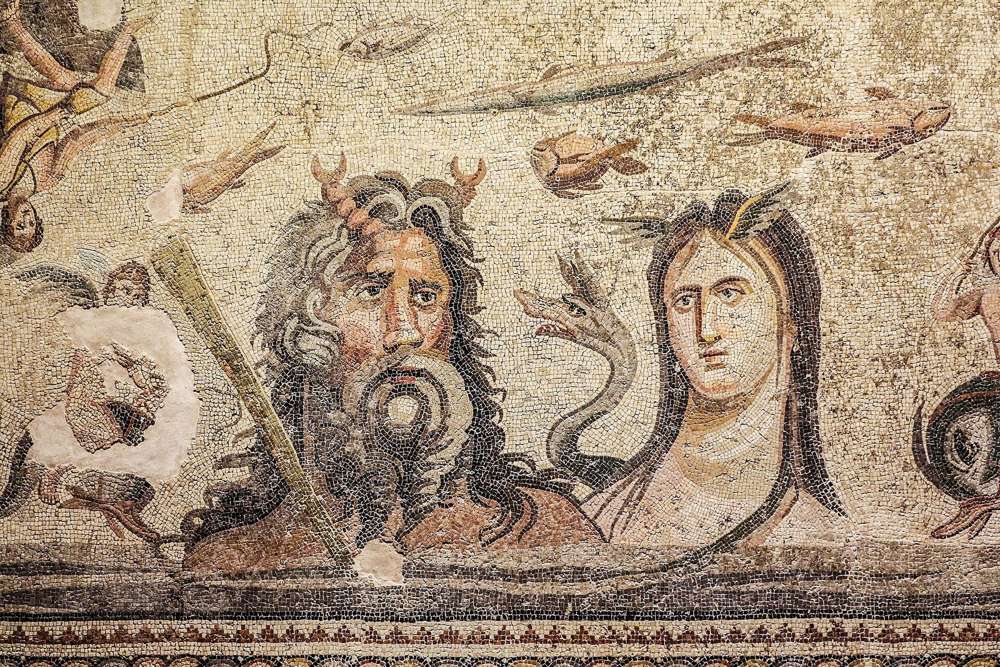
Bernard Gagnon, CC BY-SA 3.0, via Wikimedia Commons

Sources
Hesiod, Theogony 133, 337–370, 785–792; Homer, Iliad 14.201, 14.246, 18.399, 18.607–608; Plato, Theaetetus 152e; Orphic Hymn 83; Arrian, Anabasis 6.19.5.
Quotations in public-domain translations (Evelyn-White 1914, Butler 1898/1900, Taylor 1792); other authors paraphrased.