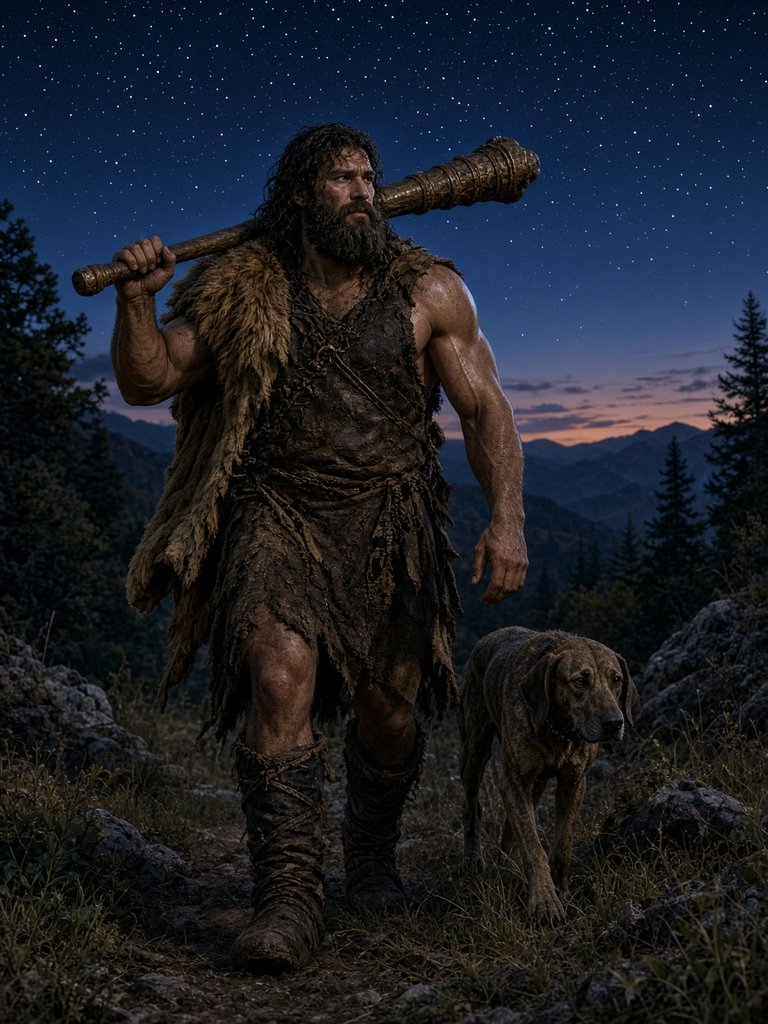
Orion is the great hunter of early myth, the tallest and handsomest of men; the giant sons of Aloeus were “the finest children that were ever born in this world, and the best looking, Orion only excepted” (Odyssey 11.309–310, tr. Butler). Kalypso complains that the gods are jealous when a goddess loves a mortal: “So when rosy-fingered Dawn made love to Orion, you precious gods were all of you furious till Diana went and killed him in Ortygia” (Odyssey 5.121–124, tr. Butler).
Odysseus sees him among the dead: “After him I saw huge Orion in a meadow full of asphodel driving the ghosts of the wild beasts that he had killed upon the mountains, and he had a great bronze club in his hand, unbreakable for ever and ever” (Odyssey 11.572–575, tr. Butler). Already in Homer he is the constellation on the shield of Achilles (Iliad 18.486–489), and Hesiod times the harvest by his rising (Works and Days 597–619).
Later writers made him a son of Poseidon who could walk on the sea. Blinded by Oinopion of Chios, he was healed by the rays of Helios, carried off by Eos, and killed by Artemis, either for challenging her at the discus or by a scorpion she sent (Apollodorus 1.4.3–5, paraphrased).
Epithets
- πελώριος · pelōrios
- huge (Odyssey 11.572)
Symbols and virtues
The hunter’s strength, and the stars that mark the seasons. Symbols: the bronze club, the hound, the constellation.
Myths
- Loved by Dawn. Odyssey 5.121–124.
- Hunting among the dead. Odyssey 11.572–575.
- The constellation. Iliad 18.486–489; Works and Days 597–619.
- Blinded and healed. Apollodorus 1.4.3–5.
Cult and places
- Tanagra. His tomb was shown there (Pausanias 9.20.3).
In the poets
“I saw huge Orion in a meadow full of asphodel driving the ghosts of the wild beasts that he had killed upon the mountains.”Homer, Odyssey 11.572–573, tr. Samuel Butler (1900), public domain.
Sources
Homer, Iliad 18.486–489; Odyssey 5.121–124, 11.309–310, 11.572–575; Hesiod, Works and Days 597–619; Apollodorus 1.4.3–5; Pausanias 9.20.3.
Quotations in public-domain translations (Evelyn-White 1914, Butler 1898/1900, Taylor 1792); other authors paraphrased.