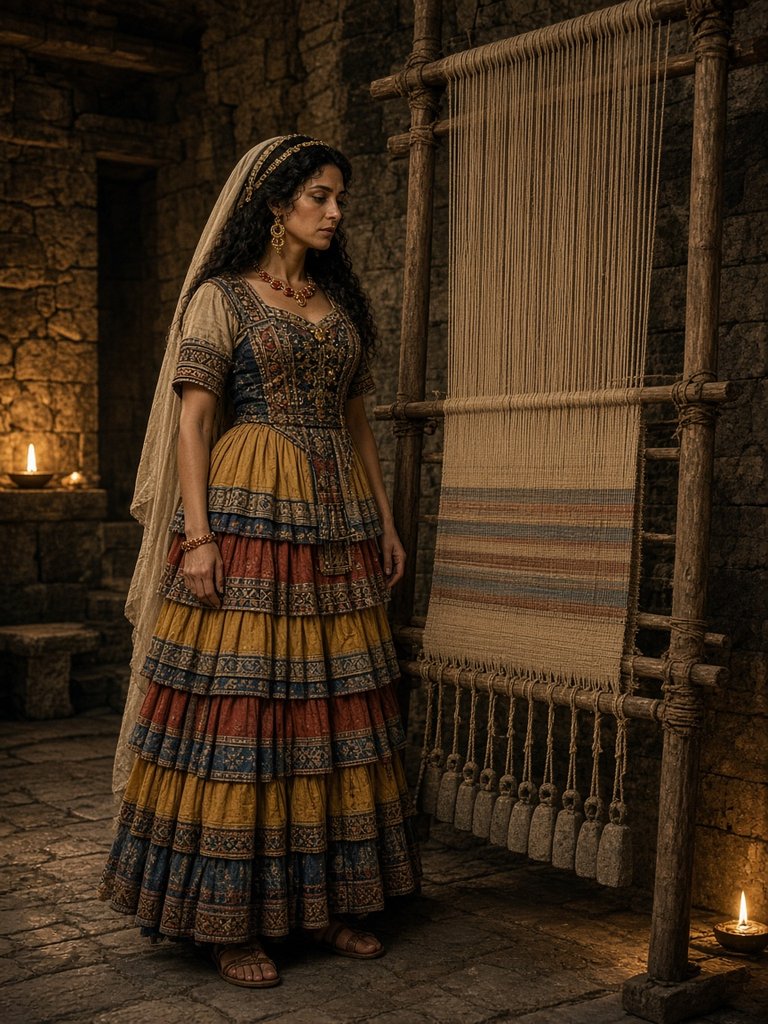
Penelope, daughter of Ikarios of Sparta, is the wife of Odysseus and mother of Telemachos. For twenty years she kept his house while the suitors of Ithaca feasted in it and pressed her to marry one of them. She put them off with the shroud she was weaving for old Laertes: the suitor Antinoos complains that “we could see her working on her great web all day long, but at night she would unpick the stitches again by torchlight” (Odyssey 2.104–105, tr. Butler).
When the stranger in rags comes home she tests him more subtly than he tests her. She sets the contest of the bow; and when he has killed the suitors, she will not believe him until she asks for their bed to be moved, and he, in anger, tells how he built it round the trunk of a living olive tree, a thing only the two of them knew (Odyssey 23.173–204). In the underworld the ghost of Agamemnon, betrayed by his own wife, praises her: “The fame, therefore, of her virtue shall never die, and the immortals shall compose a song that shall be welcome to all mankind in honour of the constancy of Penelope” (Odyssey 24.196–198, tr. Butler).
At Sparta Pausanias saw an image of Aidos, Modesty, said to have been set up by Ikarios where Penelope, leaving with Odysseus, drew her veil over her face rather than answer whether she would stay with her father (Pausanias 3.20.10–11, paraphrased). Other stories gave her another end: the Mantineans showed her tomb, and Herodotus reports the Greek tradition that the god Pan was her son by Hermes (Pausanias 8.12.5–6; Herodotus 2.145–146, paraphrased).
Epithets
- περίφρων · periphrōn
- very wise, prudent (Odyssey 1.329)
- κούρη Ἰκαρίοιο · kourē Ikarioio
- daughter of Ikarios
Symbols and virtues
Faithfulness, patience and the clever mind of a queen. Symbols: the loom and the shroud, the bow of Odysseus, the olive-tree bed, the veil.
Myths
- The web. Odyssey 2.93–110, 19.137–156, 24.128–146.
- The contest of the bow. Odyssey 21.
- The test of the bed. Odyssey 23.173–204.
- Praised by Agamemnon. Odyssey 24.192–202.
- The veil. Pausanias 3.20.10–11.
Cult and places
- Sparta. Image of Aidos where she veiled her face (Pausanias 3.20.10–11).
- Mantineia. Her tomb (Pausanias 8.12.5–6).
In the poets
“The fame, therefore, of her virtue shall never die, and the immortals shall compose a song that shall be welcome to all mankind in honour of the constancy of Penelope.”Homer, Odyssey 24.196–198, tr. Samuel Butler (1900), public domain.
Sources
Homer, Odyssey 1.328–364, 2.93–110, 19.137–156, 21, 23, 24.192–202; Herodotus 2.145–146; Pausanias 3.12.1–2, 3.20.10–11, 8.12.5–6.
Quotations in public-domain translations (Evelyn-White 1914, Butler 1898/1900, Taylor 1792); other authors paraphrased.