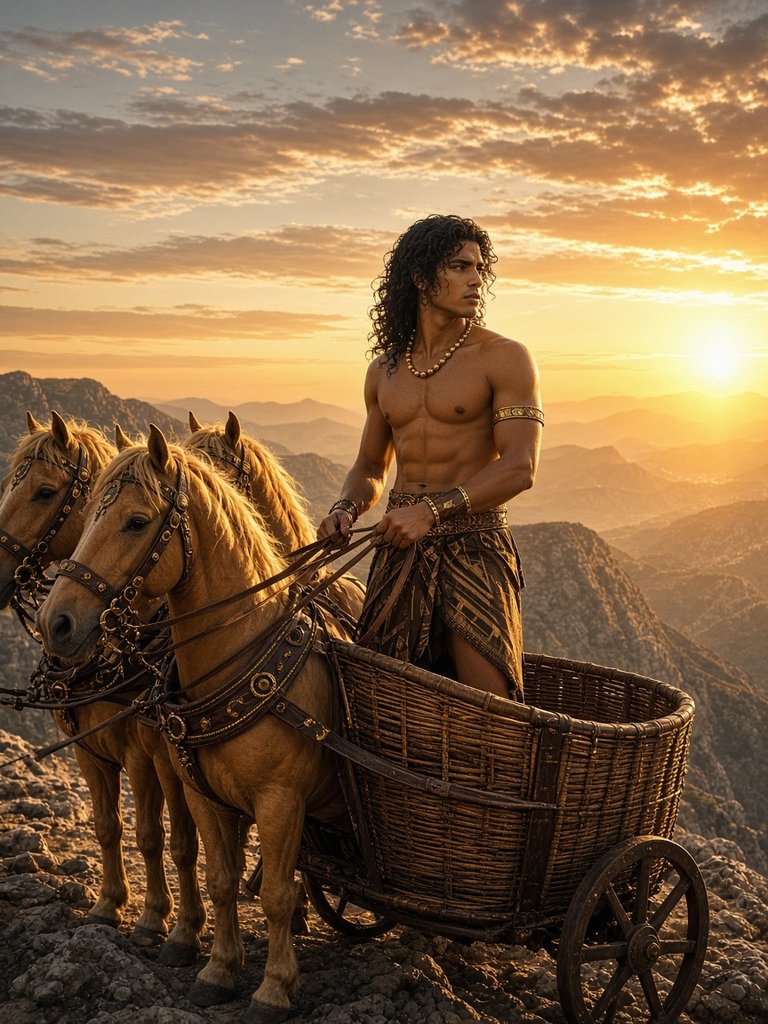
Two youths bear the name Phaethon, “the Shining”. In Hesiod he is the son of Eos and Kephalos, carried off by Aphrodite: “And to Cephalus she bare a splendid son, strong Phaethon, a man like the gods, whom, when he was a young boy in the tender flower of glorious youth with childish thoughts, laughter-loving Aphrodite seized and caught up and made a keeper of her shrine by night, a divine spirit” (Theogony 986–991, tr. Evelyn-White).
The more famous Phaethon is the son of Helios and the Okeanid Klymene. Taunted that the Sun was not his father, he went to his father’s palace in the east and asked for proof; Helios swore by the Styx to grant any wish, and the boy asked to drive the chariot of the Sun for one day. He could not hold the horses; the chariot ran wild, scorching the earth and drying the rivers, until Zeus struck him with a thunderbolt and he fell into the river Eridanos (Ovid, Metamorphoses 1.750–2.328, paraphrased). The story was told by Euripides in his lost Phaethon.
His sisters the Heliades, weeping for him on the banks of the Eridanos, were changed into poplars, and their tears hardened into amber (Ovid, Metamorphoses 2.340–366; Apollonius, Argonautica 4.595–626, paraphrased). His friend Kyknos, mourning him, became the swan.
Epithets
- ἴφθιμος · iphthimos
- strong (Theogony 987)
- ἀνὴρ ἐπιείκελος θεοῖς · anēr epieikelos theois
- a man like the gods (Theogony 987)
Symbols and virtues
Bright youth, longing for a divine father, the danger of power beyond one’s strength. Symbols: the chariot of the Sun and its four horses, the thunderbolt, poplars and amber.
Myths
- Son of Eos, taken by Aphrodite. Theogony 986–991.
- The oath of Helios. Ovid, Metamorphoses 2.31–102.
- The wild ride. Metamorphoses 2.150–324.
- The Heliades. Metamorphoses 2.340–366; Apollonius 4.595–626.
- Kyknos. Metamorphoses 2.367–380.
In the poets
“Strong Phaethon, a man like the gods, whom, when he was a young boy in the tender flower of glorious youth with childish thoughts, laughter-loving Aphrodite seized and caught up and made a keeper of her shrine by night, a divine spirit.”Hesiod, Theogony 987–991, tr. H. G. Evelyn-White (1914), public domain.
Sources
Hesiod, Theogony 986–991; Euripides, Phaethon (fragments); Apollonius of Rhodes, Argonautica 4.595–626; Ovid, Metamorphoses 1.750–2.380; Pausanias 1.4.1.
Quotations in public-domain translations (Evelyn-White 1914, Butler 1898/1900, Taylor 1792); other authors paraphrased.