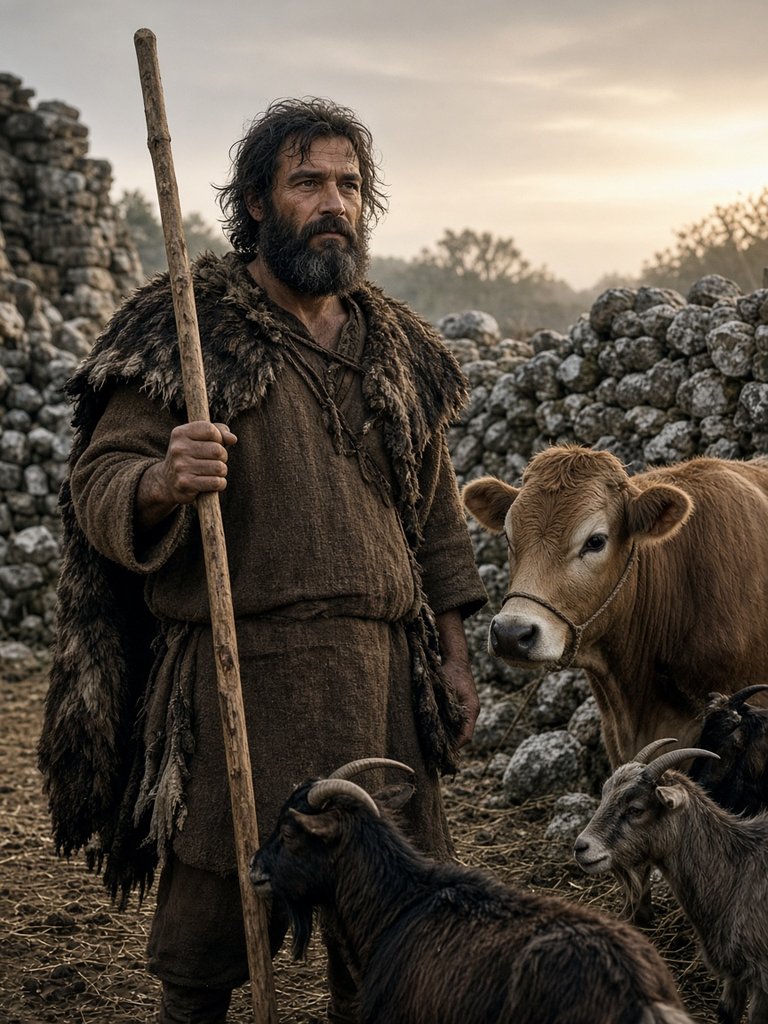
Philoitios is the chief cowherd of Odysseus, in charge of his cattle on the mainland. He appears on the day of the archery contest: “Then a third man, Philoetius, joined them, who was bringing in a barren heifer and some goats” (Odyssey 20.185–186, tr. Butler).
Without knowing who the beggar is, he greets him kindly and weeps at the thought that his master may be wandering in such rags. He says he would long ago have taken the herds to another king, but still hopes Odysseus will come home and scatter the suitors (Odyssey 20.191–225, paraphrased).
Odysseus reveals himself to him and to Eumaios by showing his scar, and promises them both wives, houses and the rank of brothers to Telemachos (Odyssey 21.188–227, paraphrased). Philoitios bars the courtyard gate, and in the battle he kills Ktesippos, who had thrown an ox-hoof at the beggar (Odyssey 22.285–291, paraphrased).
Epithets
- ὄρχαμος ἀνδρῶν · orchamos andrōn
- leader of men
- βουκόλος · boukolos
- the cowherd
Symbols and virtues
Loyalty that waits in hope. Symbols: the herdsman’s staff, the heifer, the barred gate.
Myths
- Greeting the beggar. Odyssey 20.185–240.
- The scar. Odyssey 21.188–244.
- Barring the gate. Odyssey 21.388–391.
- Against the suitors. Odyssey 22.285–291.
In the poets
“Then a third man, Philoetius, joined them, who was bringing in a barren heifer and some goats.”Homer, Odyssey 20.185–186, tr. Samuel Butler (1900), public domain.
Sources
Homer, Odyssey 20.185–240, 21.188–244, 21.388–391, 22.101–115, 22.170–200, 22.285–291.
Quotations in public-domain translations (Evelyn-White 1914, Butler 1898/1900, Taylor 1792); other authors paraphrased.