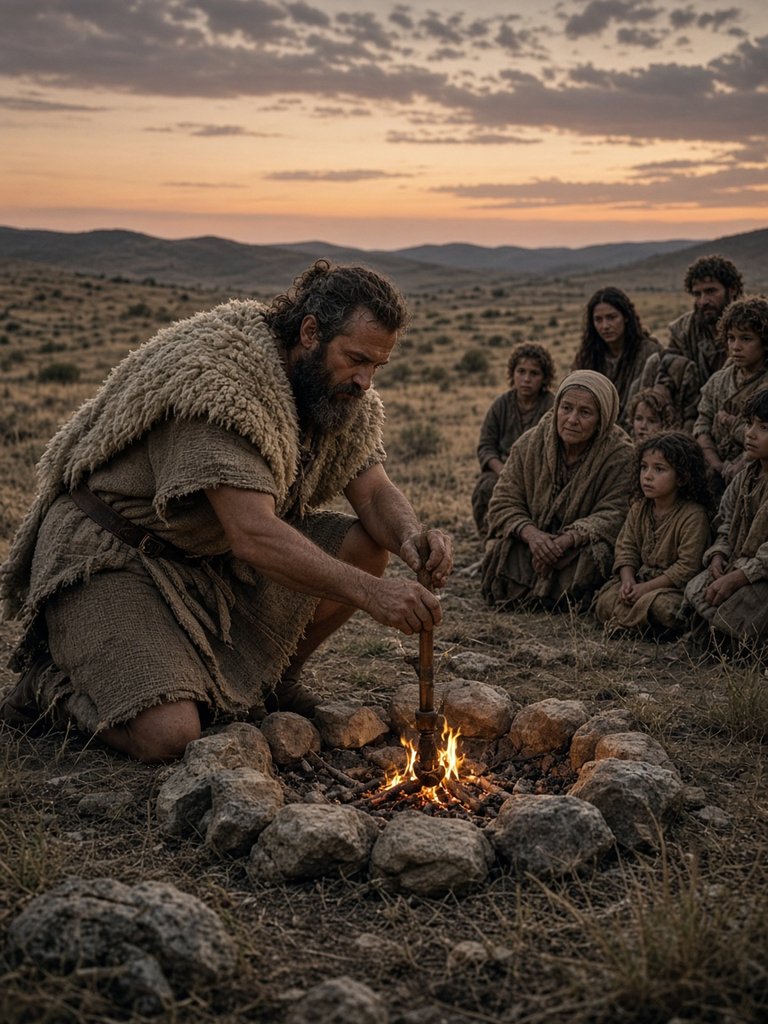
Phoroneus was the first ruler of Argos, son of the river Inachos and the nymph Melia (Apollodorus 2.1.1, paraphrased). The Argives called him the first man, and Plato has Solon begin his account of the ancient past with Phoroneus, said to be the first, and Niobe (Timaeus 22a, paraphrased).
Pausanias says that Phoroneus first gathered the people, who had been living scattered, into a single community, called the town of Phoroneus. When Hera and Poseidon disputed the land, he was one of the judges who awarded it to Hera, and so Poseidon dried up its rivers (Pausanias 2.15.5, paraphrased).
The Argives said that it was Phoroneus, not Prometheus, who gave fire to men, and they kept a fire burning that they called the fire of Phoroneus; Pausanias also saw his tomb at Argos (Pausanias 2.19.5, 2.20.3, paraphrased). He was father of Apis and of Niobe, the first mortal woman loved by Zeus (Apollodorus 2.1.1, paraphrased).
Epithets
- πρῶτος ἄνθρωπος · prōtos anthrōpos
- the first man
Symbols and virtues
Beginnings: the first community, the first fire. Symbols: the hearth fire, the gathered people.
Myths
- Son of Inachos. Apollodorus 2.1.1.
- The first man. Plato, Timaeus 22a.
- Judge between Hera and Poseidon. Pausanias 2.15.5.
- The fire of Phoroneus. Pausanias 2.19.5.
Cult and places
- Argos. A fire called the fire of Phoroneus was kept burning, and his tomb was shown (Pausanias 2.19.5, 2.20.3).
Sources
Plato, Timaeus 22a; Apollodorus 2.1.1; Pausanias 2.15.5, 2.19.5, 2.20.3.
Quotations in public-domain translations (Evelyn-White 1914, Butler 1898/1900, Taylor 1792); other authors paraphrased.