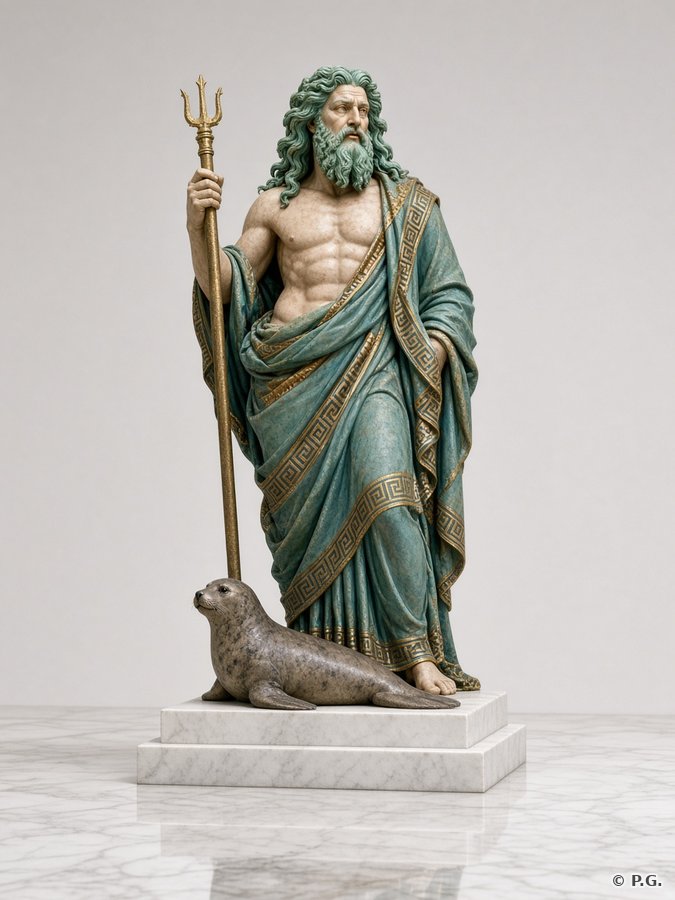
Proteus is an Old Man of the Sea, the immortal seer of Egypt who knows the depths of every sea and serves Poseidon (Odyssey 4.384–386). When Menelaos was becalmed on the island of Pharos, Proteus’ daughter Eidothea told him how to catch her father: at noon he comes out of the sea, counts his seals and lies down among them like a shepherd among his flock (Odyssey 4.400–413).
Seized, Proteus turned into a lion, a serpent, a leopard, a great boar, running water and a tall tree, but Menelaos and his men held on (Odyssey 4.454–459). Then he answered truly: he told Menelaos how to return home, the fates of Aias and Agamemnon, that Odysseus was held by Kalypso, and that Menelaos himself would not die but be sent to the Elysian plain (Odyssey 4.472–569). Herodotus heard in Egypt of a king Proteus with a precinct at Memphis (Herodotus 2.112). The Orphic hymn makes him the “first-born” who holds the keys of the sea and knows all that was, is and shall be (Orphic Hymn 25).
Epithets
- Ἅλιος γέρων · Halios geron
- old man of the sea (Odyssey 4.384)
- Νημερτής · Nemertes
- unerring (Odyssey 4.384)
- Αἰγύπτιος · Aigyptios
- of Egypt (Odyssey 4.385)
Domains and symbols
Prophecy, the depths of the sea, change of shape. Admire: holding fast through every change until the truth is told. Sacred symbols: seals, the sea, the shifting forms.
Myths
- Becalmed on Pharos. Menelaos stranded (Odyssey 4.351–370).
- Eidothea’s counsel. Odyssey 4.383–424.
- The ambush among the seals. Odyssey 4.435–453.
- The shape-changes. Odyssey 4.454–459.
- The prophecy. Homecoming, the fates of the Greeks, Elysion (Odyssey 4.472–569).
- In Egypt. A precinct of Proteus at Memphis (Herodotus 2.112).
Offerings
Storax, the fumigation of his Orphic hymn.
Beneath the Divine Mind
Proteus is the Divine Mind as truth beneath change: the one who takes every form and, held fast, speaks without error. The Orphic hymn reads him as first nature itself, changing matter into all its forms. Like every god he stands beneath the One (The One and the Many).
Honouring Proteus today
- Steadfastness. Hold to a question until it is answered.
- Truth. Ask for counsel and listen to the whole answer.
- Hymn. Recite the Orphic hymn below.
Hymn
Proteus I call, whom Fate decrees, to keep the keys which lock the chambers of the deep; First-born, by whose illustrious pow'r alone all Nature's principles are clearly shewn.Orphic Hymn 25, To Proteus, 1–3. Tr. Thomas Taylor (1792), public domain; divine names as given on Hemera.
Eidothea Εἰδοθέα
sea goddess, daughter of Proteus, helper of Menelaos · Roman: Idothea
Eidothea is a goddess of the sea, daughter of Proteus, the Old Man of the Sea. When Menelaos and his men were stranded twenty days on Pharos and starving, fishing with bent hooks, she alone took pity, met Menelaos apart from his companions and asked why he stayed (Odyssey 4.360–372).
She told him that her father knew the way home and all that had happened, and how to hold him fast (Odyssey 4.383–424). At dawn she brought four freshly flayed sealskins from the sea, hollowed out beds in the sand, and hid Menelaos and three chosen men under the skins; when the stench of the seals was too much to bear, she put ambrosia under each man’s nose (Odyssey 4.431–446). So Proteus was caught, and Menelaos learned the road home.
Epithets: Εἰδοθέα · Eidothea (“divine form” or “knowing goddess”); Θυγάτηρ ἁλίοιο γέροντος · Thygater halioio gerontos (daughter of the Old Man of the Sea (Odyssey 4.365))
Domains and symbols: Help for the stranded, compassion joined with practical wit. Admire: pity that turns into a plan. Sacred symbols: the sealskins, ambrosia, the shore of Pharos.
Myths:
- She meets Menelaos. Alone on Pharos (Odyssey 4.360–372).
- The plan. How to seize Proteus (Odyssey 4.383–424).
- The sealskin ambush. With ambrosia against the stench (Odyssey 4.431–446).
Sources: Homer, Odyssey 4.351–480. Ancient sources are cited by book and line or section in the standard numbering. Quotations from Hesiod and the Homeric Hymns are in the translation of H. G. Evelyn-White (1914), from the Orphic Hymns in that of Thomas Taylor (1792), both public domain. Hemera gives each day's god in brief; this page is the temple's fuller account.
Sources
Homer, Odyssey 4.351–570; Herodotus 2.112; Orphic Hymn 25.
Quotations in public-domain translations (Evelyn-White 1914, Butler 1898/1900, Taylor 1792); other authors paraphrased.