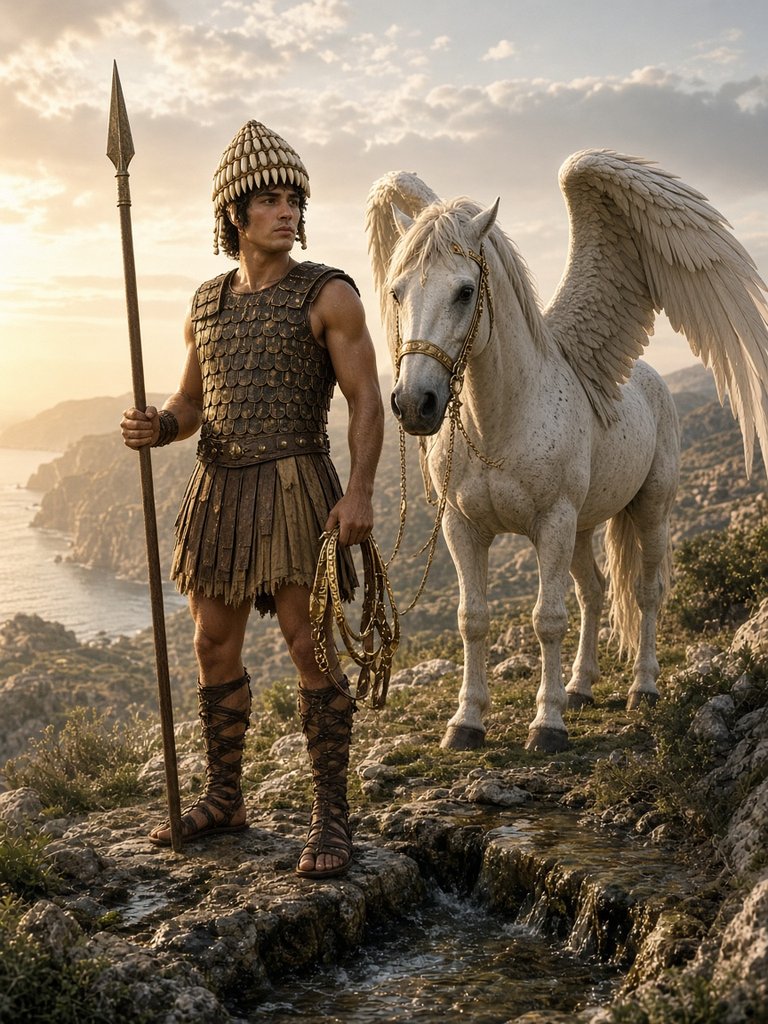
Bellerophon (Bellerophontes), grandson of Sisyphos of Corinth, is the rider of Pegasos. In the Iliad his grandson Glaukos tells the story on the field of Troy: Bellerophon, “whom heaven endowed with the most surpassing comeliness and beauty” (Iliad 6.156, tr. Butler), was falsely accused by Anteia, wife of king Proitos of Tiryns, whom he had refused. Proitos sent him to Lykia with a folded tablet bearing deadly signs, asking the king there to kill him (Iliad 6.157–170).
The Lykian king set him tasks meant to destroy him: first to kill the Chimaira, then to fight the Solymoi and the Amazons, and at last an ambush of the best men of Lykia, all of whom he killed; the king then gave him his daughter and half his kingdom (Iliad 6.171–195). Hesiod tells that “her did Pegasus and noble Bellerophon slay” (Theogony 325, tr. Evelyn-White), and Pindar how Athena gave him the golden bridle in a dream and he tamed the winged horse at the spring of Peirene in Corinth (Olympian 13.63–92, paraphrased).
Later he tried to ride Pegasos up to Olympos; the horse threw him (Pindar, Isthmian 7.44–47, paraphrased). The Iliad says only that he became hateful to the gods, and “he wandered all desolate and dismayed upon the Alean plain, gnawing at his own heart, and shunning the path of man” (Iliad 6.200–202, tr. Butler). The Corinthians showed his precinct in the cypress grove Kraneion and a fountain with Bellerophon and Pegasos (Pausanias 2.2.4, 2.3.5, paraphrased).
Epithets
- ἀμύμων · amumōn
- blameless (Iliad 6.155)
- Ἱππόνοος · Hipponoos
- his name before the deed, in later tradition
Symbols and virtues
Beauty, courage and the help of the gods, and the fall that follows pride. Symbols: Pegasos and the golden bridle, the spear, the folded tablet, the Chimaira.
Myths
- Anteia and Proitos. Iliad 6.155–170.
- The Chimaira. Iliad 6.179–183; Theogony 319–325.
- The golden bridle. Pindar, Olympian 13.63–92.
- The fall. Pindar, Isthmian 7.44–47.
- The Alean plain. Iliad 6.200–202.
Cult and places
- Corinth. Precinct in the Kraneion (Pausanias 2.2.4); fountain (Pausanias 2.3.5).
In the poets
“When Bellerophon came to be hated by all the gods, he wandered all desolate and dismayed upon the Alean plain, gnawing at his own heart, and shunning the path of man.”Homer, Iliad 6.200–202, tr. Samuel Butler (1898), public domain.
Sources
Homer, Iliad 6.144–211; Hesiod, Theogony 319–325; Pindar, Olympian 13.63–92, Isthmian 7.44–47; Apollodorus, Library 2.3.1–2; Pausanias 2.2.4, 2.3.5, 2.4.1.
Quotations in public-domain translations (Evelyn-White 1914, Butler 1898/1900, Taylor 1792); other authors paraphrased.