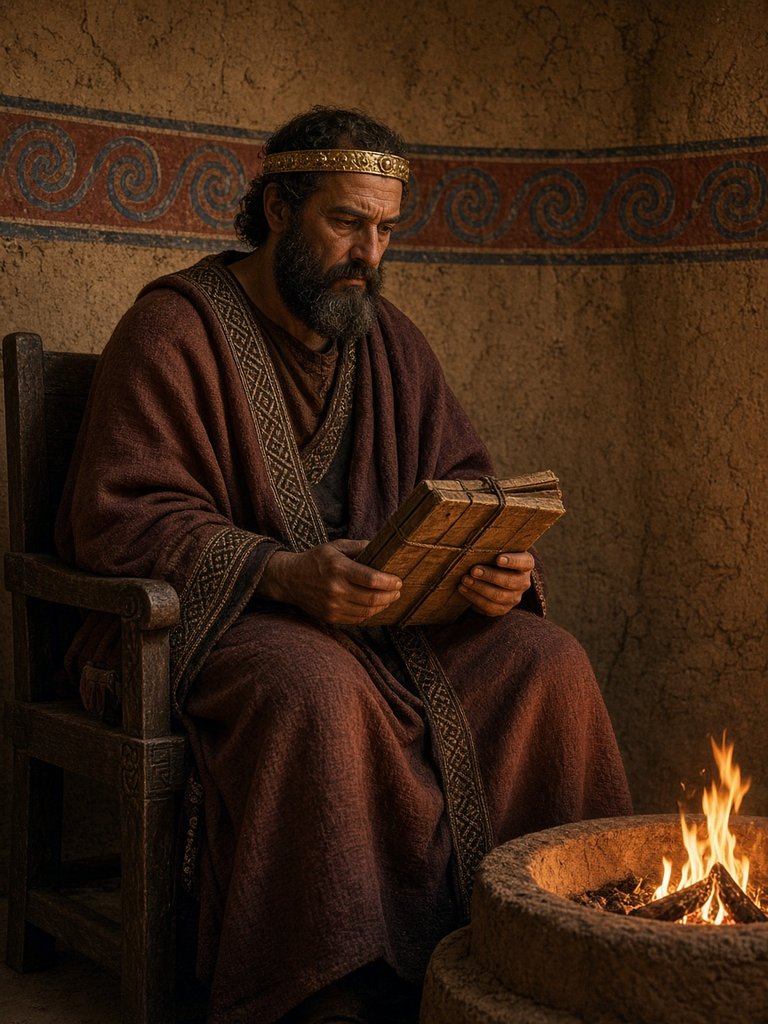
Proitos was king of Tiryns and twin brother of Akrisios. The brothers fought even before birth, and after a war between them the Argolid was divided; Proitos, helped by the Lykian king, took Tiryns, whose walls the Cyclopes were said to have built for him (Apollodorus 2.2.1; Pausanias 2.25.8, paraphrased).
In the Iliad Glaukos tells the story of his grandfather Bellerophon: “But Proetus devised his ruin, and being stronger than he, drove him from the land of the Argives, over which Jove had made him ruler” (Iliad 6.157–159, tr. Butler). His wife Anteia had falsely accused Bellerophon, and Proitos, unwilling to kill a guest himself, sent him to Lykia with a folded tablet bearing deadly signs (Iliad 6.160–170, paraphrased).
His daughters, the Proitides, went mad for scorning Dionysos or Hera and roamed the mountains, until the seer Melampous cured them in return for a share of the kingdom (Apollodorus 2.2.2, paraphrased; compare Herodotus 9.34).
Epithets
- Προῖτος · Proitos
- Proetus
Symbols and virtues
Jealous kingship and a crime done at a distance. Symbols: the folded tablet, the Cyclopean walls of Tiryns.
Myths
- The quarrel with Akrisios. Apollodorus 2.2.1.
- The walls of Tiryns. Pausanias 2.25.8.
- Bellerophon and the tablet. Iliad 6.155–170.
- The madness of his daughters. Apollodorus 2.2.2; Herodotus 9.34.
In the poets
“But Proetus devised his ruin, and being stronger than he, drove him from the land of the Argives, over which Jove had made him ruler.”Homer, Iliad 6.157–159, tr. Samuel Butler (1898), public domain.
Sources
Homer, Iliad 6.155–170; Herodotus 9.34; Apollodorus 2.2.1–2, 2.3.1; Pausanias 2.16.2, 2.25.7–8.
Quotations in public-domain translations (Evelyn-White 1914, Butler 1898/1900, Taylor 1792); other authors paraphrased.