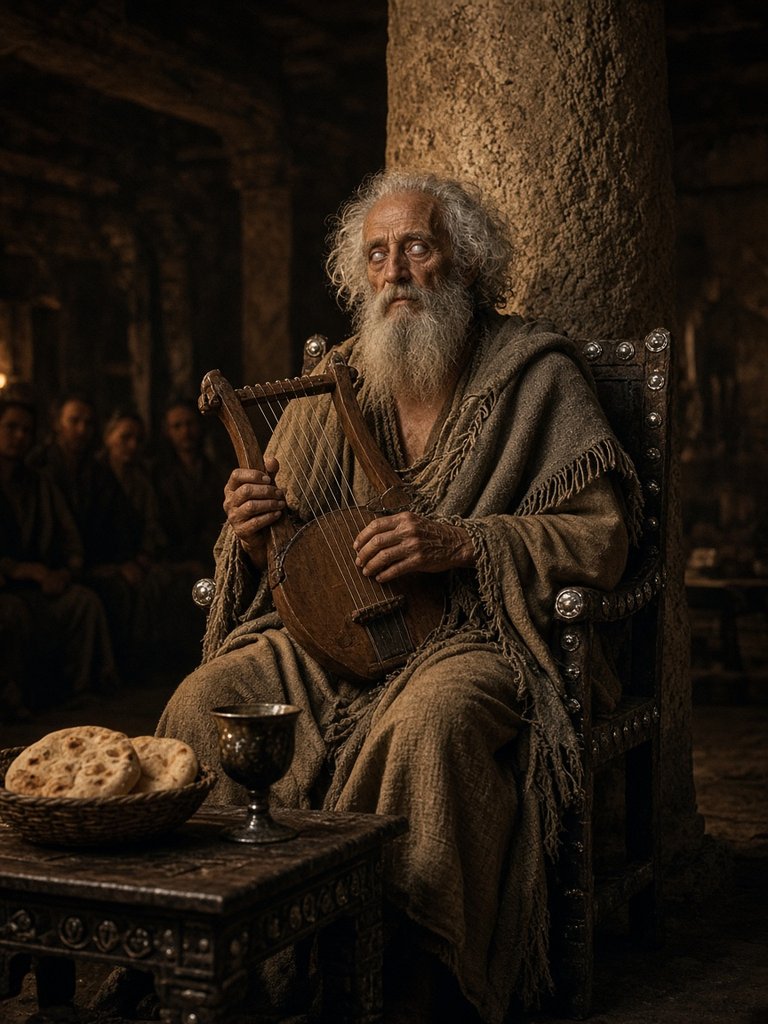
Demodokos is the bard at the court of Alkinoos on Scheria. “A servant presently led in the famous bard Demodocus, whom the muse had dearly loved, but to whom she had given both good and evil, for though she had endowed him with a divine gift of song, she had robbed him of his eyesight” (Odyssey 8.62–64, tr. Butler). The herald Pontonoos hangs his lyre on a peg over his head and shows him where to feel for it.
He sings three songs. The first is the quarrel of Odysseus and Achilles, which makes the hidden guest weep (Odyssey 8.73–95). The second is the comic tale of Ares and Aphrodite caught in Hephaistos’ net (Odyssey 8.266–366). The third, at Odysseus’ own request, is the wooden horse and the sack of Troy (Odyssey 8.487–520, paraphrased).
Odysseus honours him with the best cut of the meat, saying bards are owed respect because the Muse teaches them (Odyssey 8.477–481, paraphrased). Ancient readers often saw in the blind singer a portrait of Homer himself.
Epithets
- θεῖος ἀοιδός · theios aoidos
- the divine bard
- ἐρίηρος ἀοιδός · eriēros aoidos
- the trusty bard
Symbols and virtues
Song as the memory of heroes; blindness and inner sight. Symbols: the lyre on its peg.
Myths
- The quarrel at Troy. Odyssey 8.62–95.
- Ares and Aphrodite. Odyssey 8.266–366.
- The wooden horse. Odyssey 8.469–534.
In the poets
“Though she had endowed him with a divine gift of song, she had robbed him of his eyesight.”Homer, Odyssey 8.63–64, tr. Samuel Butler (1900), public domain.
Sources
Homer, Odyssey 8.43–108, 8.250–369, 8.469–534, 13.27–28.
Quotations in public-domain translations (Evelyn-White 1914, Butler 1898/1900, Taylor 1792); other authors paraphrased.