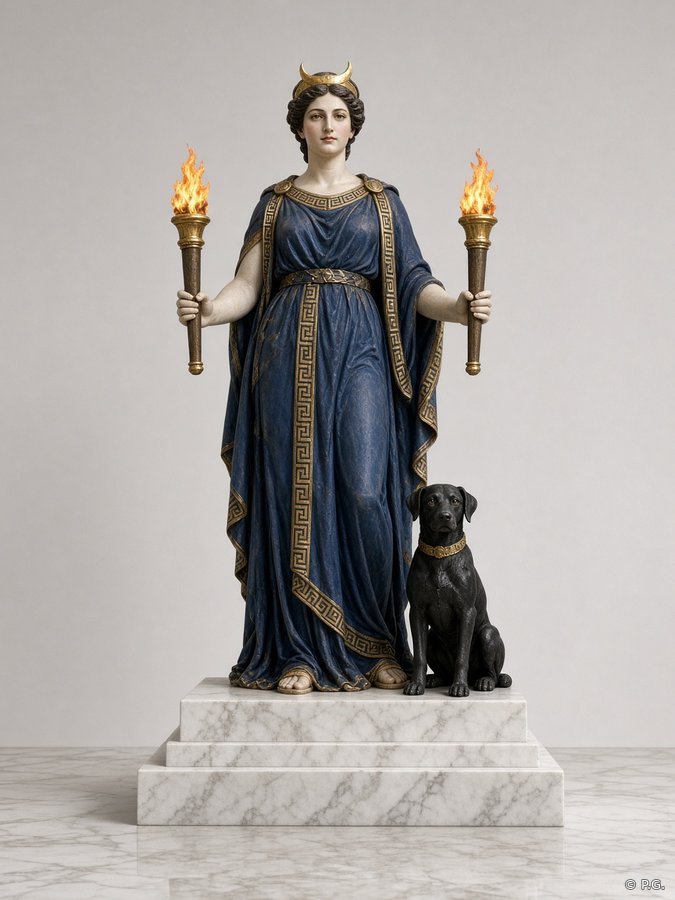
Hekate (Ἑκάτη), daughter of the Titans Perses and Asteria (Hesiod, Theogony 409–411). Zeus honoured her above all the gods: he gave her a share of the earth, the sea and the starry heaven, and she gives or withholds success to those who call on her (Theogony 411–452). She is the torch-bearer who heard the Maiden’s cry and helped Demeter seek her, the keeper of crossroads and doorways, and, for the later Platonists, the soul of the cosmos who stands between the gods and the world. From the Hellenistic age she was joined with Selene and Artemis as a goddess of the moon.
Tags: Trioditis · Propylaia · Phosphoros · Kleidouchos · Kourotrophos · Enodia
Epithets
- Τριοδῖτις · Trioditis
- of the place where three roads meet
- Προπυλαία · Propylaia
- before the gate, guardian of thresholds
- Φωσφόρος · Phosphoros
- light-bringer, bearer of torches
- Κλειδοῦχος · Kleidouchos
- holder of the keys
- Κουροτρόφος · Kourotrophos
- nurse of the young, as Zeus made her (Theogony 450–452)
- Ἐνοδία · Enodia
- of the roads and the wayside
Domains and symbols
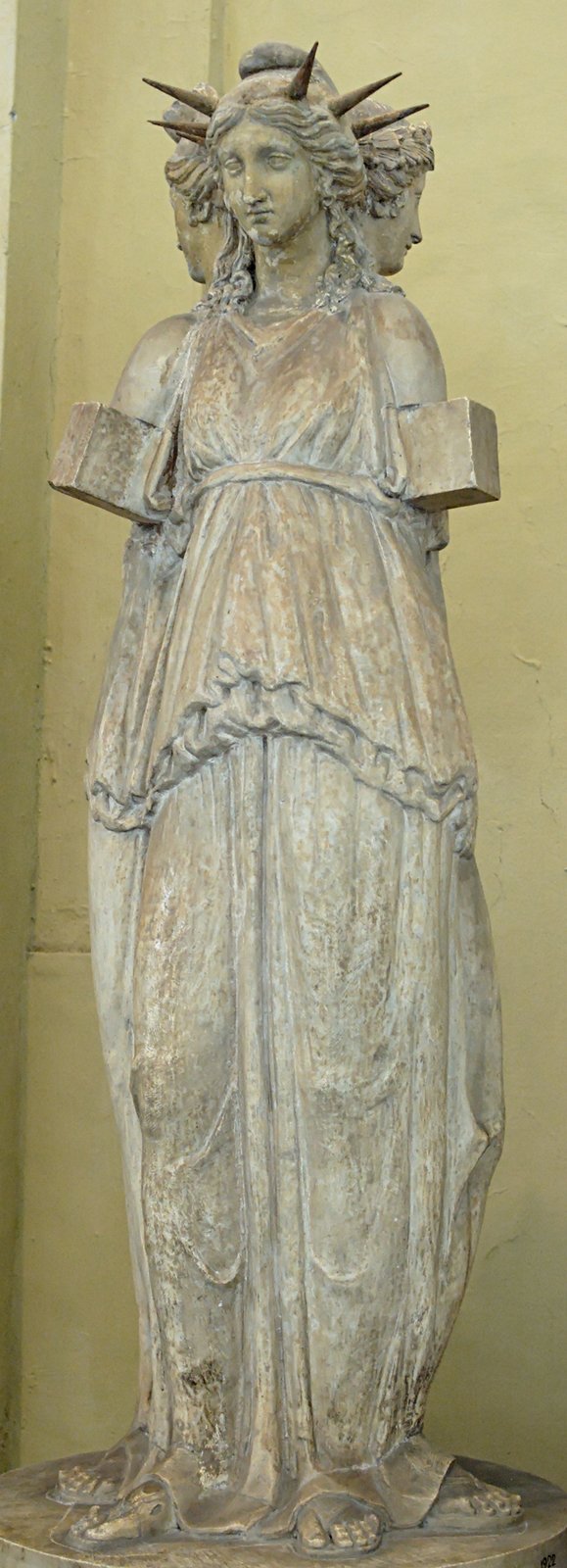
Crossroads, thresholds and doorways; night, the dark of the moon and the moon itself; purification of the house; the way between the living and the dead; magic, rightly used. Admire: protection, wise boundaries, the courage to choose a road. Sacred symbols: paired torches, keys, the dog, the serpent, the triple form, and the strophalos, the wheel of the theurgists.
Myths
- The honours of Zeus. Alone of the Titans’ line she kept every privilege she had held before, and gained more (Theogony 421–428).
- The search for Persephone. She heard the Maiden’s cry from her cave, met Demeter with a torch in her hands, and became Persephone’s attendant ever after (Homeric Hymn to Demeter 24–25, 51–61, 438–440).
- The battle with the Giants. She killed the Giant Klytios with her torches (Apollodorus, Library 1.6.2).
- Medea, her priestess. Medea served Hekate and called on her at midnight to prepare her charms (Apollonius, Argonautica 3.251–252, 3.1194–1224).
- The triple Hekate. Alkamenes was the first to make her statue in three bodies joined together, Hekate “on the Tower” by the Acropolis (Pausanias 2.30.2).
Offerings
The Deipnon, Hekate’s supper, on the last day of each lunar month: a meal set out at a crossroads or a doorway for the goddess, while the household swept and purified the house (Aristophanes, Wealth 594–597, with the ancient commentators). Modern practice: bread, eggs, honey, garlic or cheese at the threshold, left without looking back, with one thing named that you release. The Temple keeps the Deipnon every month; see the day in Hemera.
Hymn
The Orphic Hymns open with a hymn to Hekate (Orphic Hymn 1), calling her goddess of the roads and crossroads, of heaven, earth and sea, saffron-robed, rejoicing in the night and the company of the dead, the keeper of the keys of all the world.
Hekate in theurgy
In the Chaldean Oracles, the sacred text of the later Platonists, Hekate is the cosmic soul, the boundary between the realm of the intellect and the visible world, the source of life that animates all things. For the theurgists she leads the purified soul upward, and her spinning wheel, the strophalos, belongs to the rites of ascent. This is the high magic the Temple honours: purification and prayer for the soul’s rise toward the One, never workings against another. See the Chaldean Oracles and the path to henosis.
An audience with Hekate
Hekate is reached directly, without a priest. Speak with Hekate at the crossroads.