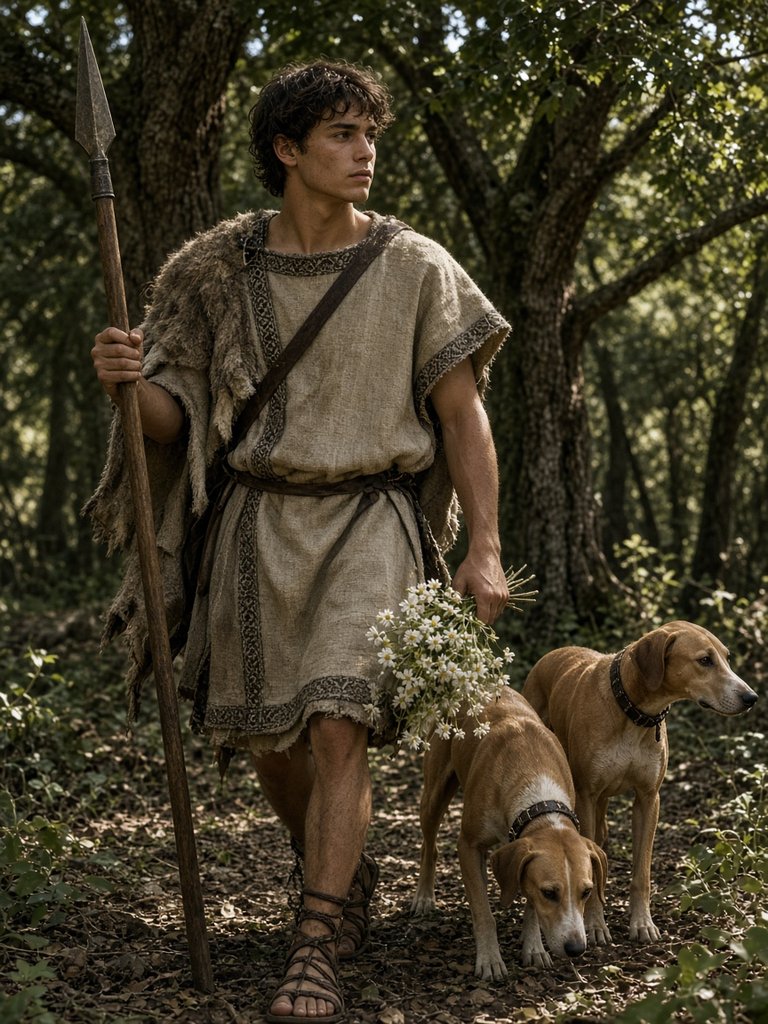
Hippolytos is the son of Theseus and an Amazon queen, raised at Troizen. A huntsman who honoured only Artemis and scorned Aphrodite, he is the hero of Euripides’ Hippolytus, where Aphrodite punishes him by making his stepmother Phaidra fall in love with him (Hippolytus 1–56, paraphrased).
When he rejects Phaidra she dies, leaving a tablet accusing him, and Theseus calls down on his son one of the three curses Poseidon had promised him. As Hippolytos drives along the shore a bull rises from the sea, his horses bolt, and he is dragged to his death (Hippolytus 1173–1254, paraphrased). Artemis appears and reveals the truth to Theseus (1283–1341).
Some said Asklepios raised him from the dead (Apollodorus 3.10.3; Pausanias 2.27.4), and in Italy he was worshipped as Virbius. At Troizen he had a sanctuary, and every girl cut a lock of her hair for him before her wedding (Euripides, Hippolytus 1423–1427; Pausanias 2.32.1, paraphrased). Homer does not mention him.
Epithets
- ἁγνός · hagnos
- pure, chaste, his virtue in Euripides
Symbols and virtues
Purity that refuses love, and the cost of a father’s curse. Symbols: the hunting spear, the hounds, the meadow garland.
Myths
- Devotion to Artemis. Euripides, Hippolytus 58–87.
- Phaidra’s love. Euripides, Hippolytus.
- The bull from the sea. Euripides, Hippolytus 1173–1254.
- Raised by Asklepios. Apollodorus 3.10.3.
Cult and places
- Troizen. Sanctuary and the bridal offering of hair (Pausanias 2.32.1–4).
- Aricia. Worshipped as Virbius (Pausanias 2.27.4).
Sources
Euripides, Hippolytus; Apollodorus 3.10.3, Epitome 1.17–19; Pausanias 2.27.4, 2.32.1–4; Ovid, Metamorphoses 15.497–546.
Quotations in public-domain translations (Evelyn-White 1914, Butler 1898/1900, Taylor 1792); other authors paraphrased.