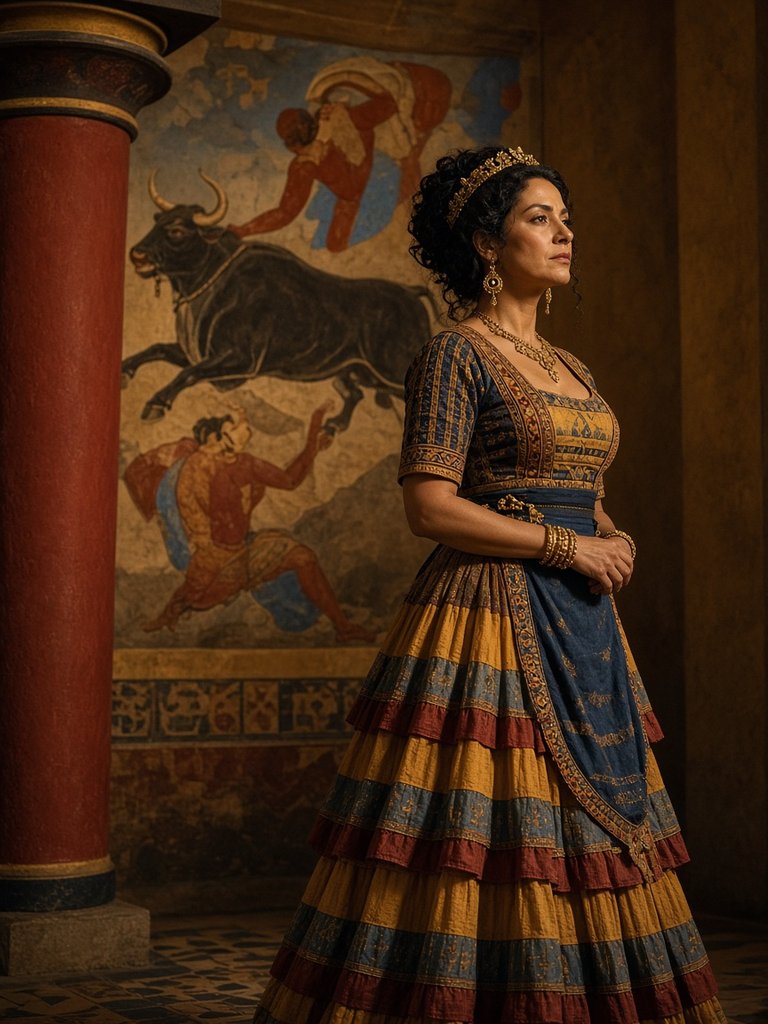
Pasiphae, she who shines on all, is a daughter of Helios, sister of Kirke and Aietes, and wife of Minos, king of Knossos. She bore him Ariadne, Phaidra, Androgeos and other children (Apollodorus 3.1.2, paraphrased).
Minos prayed to Poseidon to send a bull from the sea as a sign of his kingship, promising to sacrifice it, but kept the beautiful animal for himself. In anger Poseidon made Pasiphae desire the bull. The craftsman Daidalos built her a hollow wooden cow, and she bore the Minotaur, named Asterios, a man with a bull’s head, whom Minos shut in the Labyrinth (Apollodorus 3.1.3–4, paraphrased). Euripides told the story in his lost Cretans.
Apollodorus adds that she used her sorcery to punish Minos’ unfaithfulness (3.15.1). At Thalamai in Laconia there was an oracle of a goddess called Pasiphae, consulted in dreams (Pausanias 3.26.1; Plutarch, Agis 9). Homer and Hesiod do not tell her story.
Epithets
- Πασιφάη · Pasiphaē
- all-shining, the meaning of her name
Symbols and virtues
Desire sent as a god’s punishment. Symbols: the bull from the sea, the wooden cow, the Labyrinth.
Myths
- Daughter of Helios. Apollodorus 3.1.2.
- The bull from the sea. Apollodorus 3.1.3–4.
- Mother of the Minotaur. Apollodorus 3.1.4; Euripides, Cretans (fragments).
Cult and places
- Thalamai. Dream oracle of Pasiphae (Pausanias 3.26.1).
Sources
Apollodorus 3.1.2–4, 3.15.1; Euripides, Cretans (fragments); Diodorus 4.77; Pausanias 3.26.1; Ovid, Ars Amatoria 1.289–326.
Quotations in public-domain translations (Evelyn-White 1914, Butler 1898/1900, Taylor 1792); other authors paraphrased.