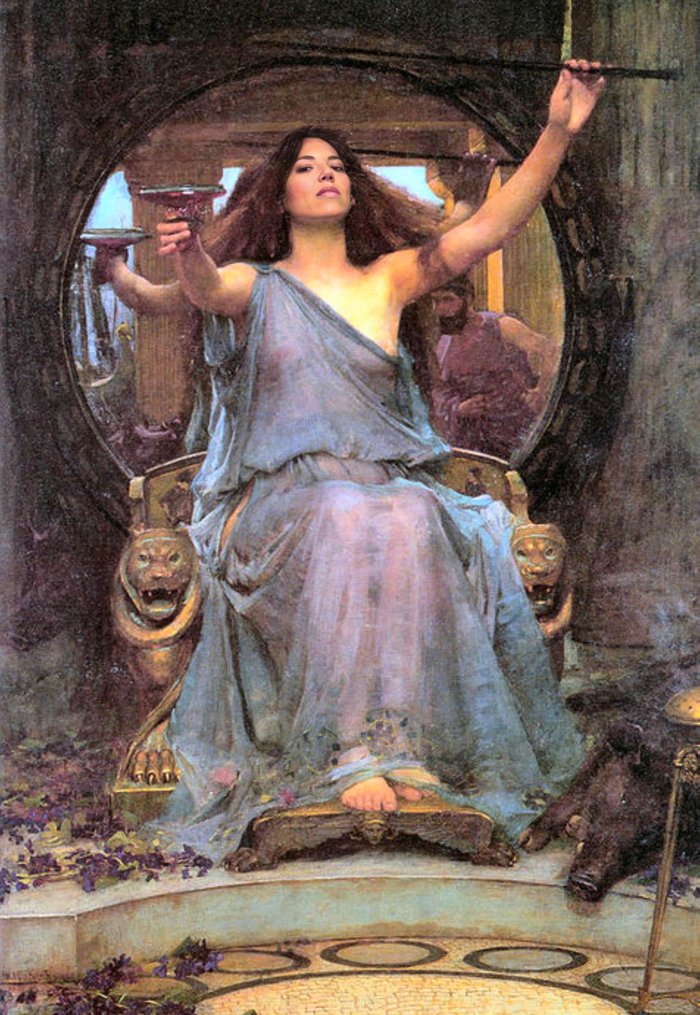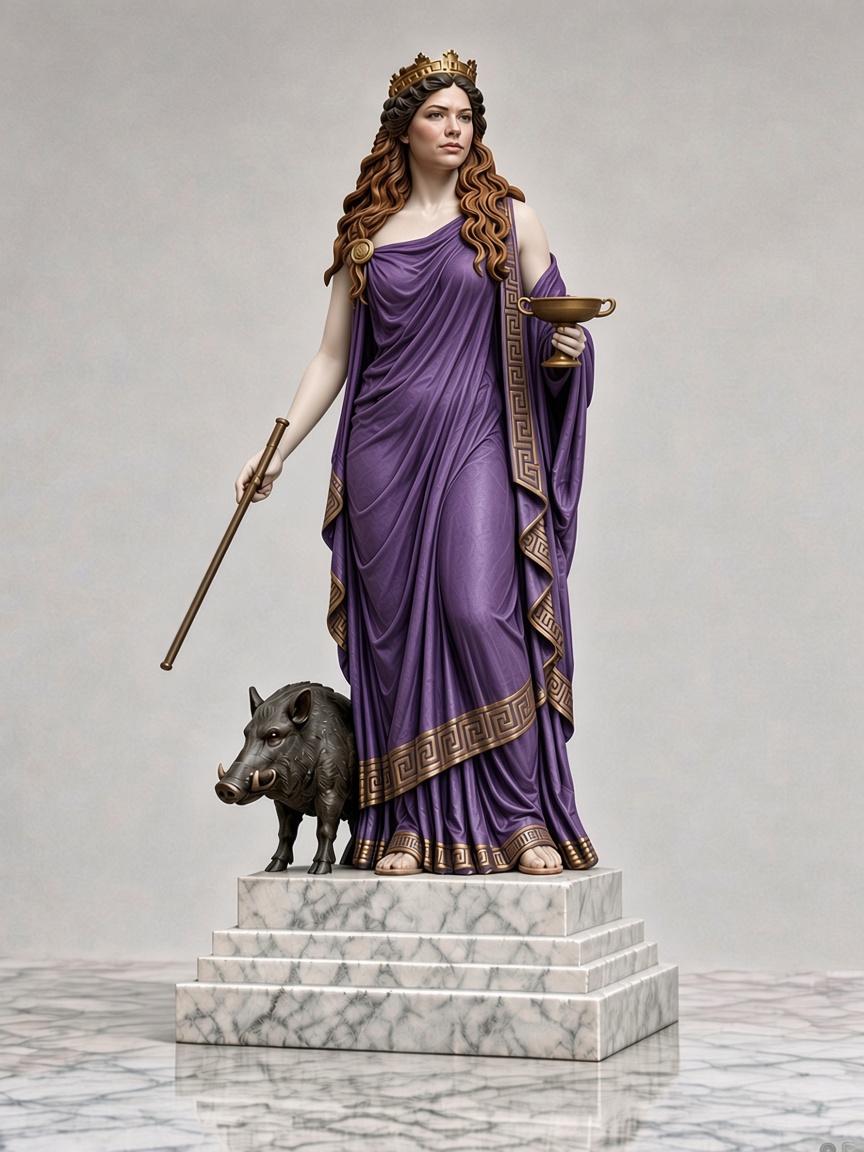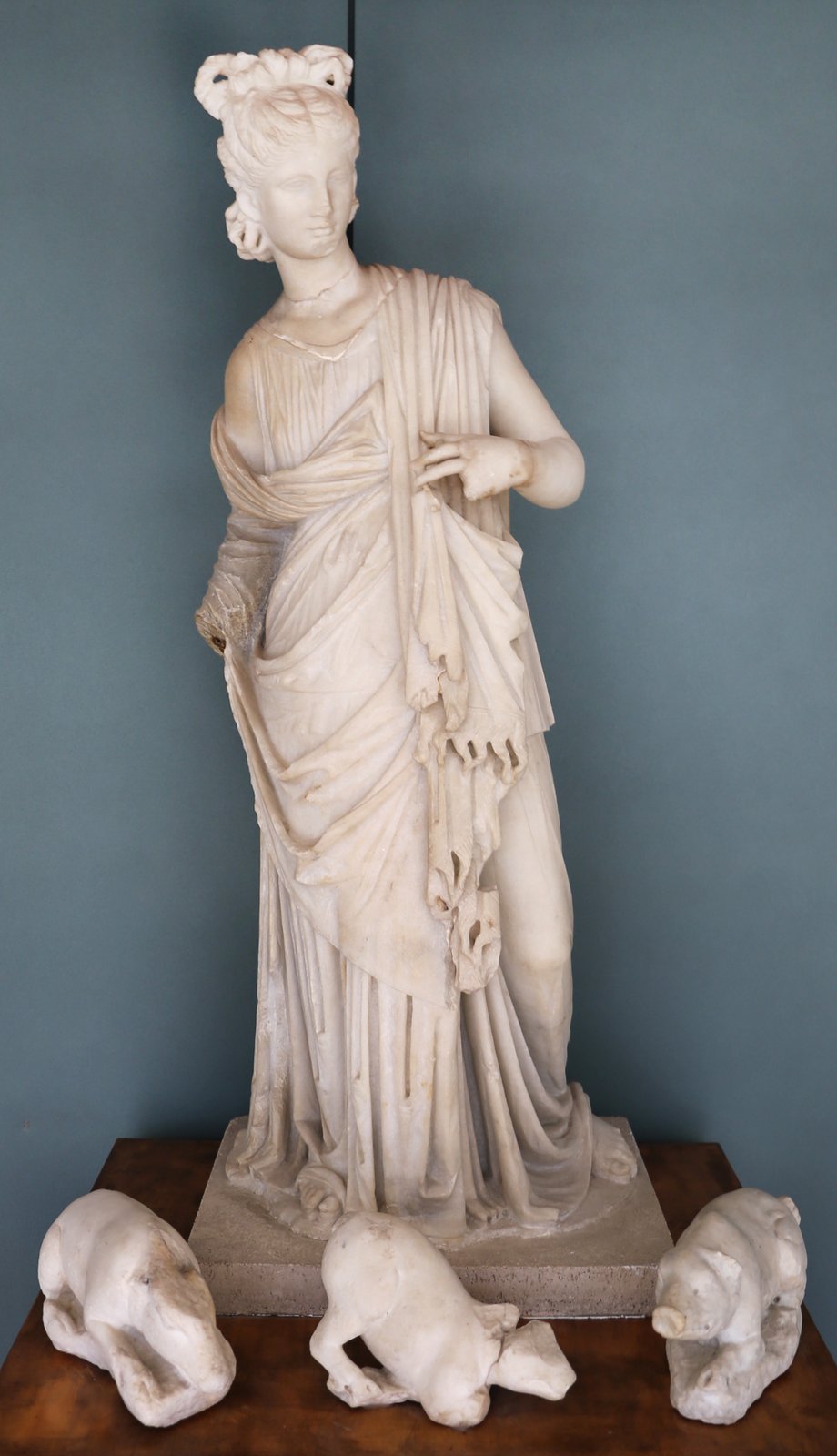
Kirki (Κίρκη), daughter of Helios and the Oceanid Perse, sister of Aietes (Odyssey 10.135–139; Theogony 956–957). A goddess who lives on the island of Aiaia with her nymph attendants; Homer calls her ‘of many drugs’ (polypharmakos, Odyssey 10.276) and ‘dread goddess with human speech’ (deine theos audeessa, 10.136).
Tags: Polypharmakos · Deine theos audeessa · Aiaia
Epithets
- Πολυφάρμακος · Polypharmakos
- of many drugs (Odyssey 10.276)
- Δεινὴ θεὸς αὐδήεσσα · Deine theos audeessa
- dread goddess with human speech (Odyssey 10.136)
- of Aiaia
- her island home in the Odyssey
Domains and symbols
Herbs and drugs (pharmaka), transformation, enchantment, purification, knowledge of the way to the dead. Admire: hospitality kept once trust is sworn, frank counsel, skill with plants. Sacred symbols: wand, cup, the herb moly, loom, tame wolves and lions.
Myths
- Odysseus’ men turned to swine. Hermes’ gift of moly (Odyssey 10).
- The year on Aiaia and the journey to the Underworld (Odyssey 10–11).
- Counsel on the Sirens and Scylla and Charybdis (Odyssey 12).
- Telegonos and the end of Odysseus in the lost Telegony.
- Purification of Jason and Medea (Apollonius, Argonautica 4.659–752).
- Scylla turned into a monster in a later Latin tale (Ovid, Metamorphoses 14).
Offerings
Modern practice: herbs from your garden or kitchen, honey, a cup of wine, or a little barley and cheese, recalling her hospitality (Odyssey 10.234–235).
Hymn
There is no Orphic Hymn to Kirki, and no Homeric Hymn. Her story is told in the Odyssey and later poets; a small cult of Kirki is attested at the Roman colony of Circeii in Italy (Cicero, On the Nature of the Gods 3.48; Strabo 5.3.6).
Arrival at Aiaia (Odyssey 10.133–243)
After the Laistrygonians destroyed all but one of his ships, Odysseus reached Aiaia, home of Kirki, ‘a dread goddess with human speech’, daughter of Helios and Perse. Eurylochos led a scouting party to her stone house in the woods, where tame wolves and lions fawned on them. Kirki, singing at her loom, invited them in and gave them cheese, barley, honey and Pramnian wine mixed with her drugs; a stroke of her wand turned them into swine, though their minds stayed human. Only Eurylochos stayed outside and fled back to the ship.
The herb moly (Odyssey 10.274–347)
On his way to rescue them Odysseus met Hermes in the form of a young man. Hermes gave him the herb moly, black at the root with a milk-white flower, hard for mortals to dig up, and told him what to do. Kirki’s potion had no power over him; when she struck him with her wand he drew his sword, and she fell at his knees, recognising Odysseus, whose coming Hermes had foretold. At his demand she swore the great oath of the gods to plot no harm, and then restored his men, younger and handsomer than before.
The year together (Odyssey 10.348–574)
Odysseus and his crew stayed a full year in Kirki’s house, feasting. When his men urged him homeward, Kirki told him he must first sail to the house of Hades and Persephone to consult the shade of the Theban seer Teiresias, and taught him the rites: a pit, libations of milk and honey, wine and water, barley, and the sacrifice of a ram and a black ewe. Young Elpenor, asleep on her roof, fell to his death as they left.
Counsel for the voyage (Odyssey 12.1–156)
Returning from the Underworld, Odysseus buried Elpenor, and Kirki gave him counsel for the way home: to stop his crew’s ears with wax and be bound to the mast to hear the Sirens; to choose between the Wandering Rocks and the strait of Scylla and Charybdis, steering close to Scylla’s cliff and losing six men rather than all to Charybdis; and never to harm the cattle of Helios on Thrinakia. Then she sent a fair wind after his ship.
The lost sequel: the Telegony
The story continued in the lost sequel to the Odyssey, the Telegony, an epic of the Epic Cycle attributed to Eugammon of Cyrene and known today mainly from the summary in Proclus’ Chrestomathy. Telegonos, son of Kirki and Odysseus, sailed to Ithaca in search of his father and, not knowing him, killed Odysseus with a spear tipped with the spine of a stingray. Learning his mistake, he carried his father’s body, with Penelope and Telemachus, to Kirki’s island. There Kirki made them immortal; Telegonos married Penelope, and Telemachus married Kirki (Proclus, Chrestomathy, summary of the Telegony; Apollodorus, Epitome 7.36–37).
Kirki in later poets
Apollonius has Kirki purify Jason and Medea, her niece, of the murder of Apsyrtos with the blood of a suckling pig (Argonautica 4.659–752). In the Roman poet Ovid, she turns the nymph Scylla into a monster out of jealousy over the sea-god Glaukos (Ovid, Metamorphoses 14.1–74), and turns King Picus into a woodpecker (14.320–396).
Song
- Σωκράτης Μάλαμας (Sokratis Malamas), Κίρκη (Kirki), live cover (Sokratis Malamas Official, YouTube)
Words and music by Sokratis Malamas; first recorded by Nikos Papazoglou on the album Paramythia (1991). Here Malamas sings it live.
From the refrain:
Μάγισσα Κίρκη πού με πας
σε ποια γωνιά μ’ αφήνεις και με σβήνεις
ζω στο δικό σου κόσμο κι απορώSorceress Kirki, where are you taking me,Draft translation. The song is under copyright, so only a short excerpt is quoted; full lyrics: stixoi.info.
in what corner do you leave me and extinguish me?
I live in your world, bewildered.
Images
Sources
Homer, Odyssey 10–12; Hesiod, Theogony 956–957, 1011–1016; the Telegony (Proclus, Chrestomathy; Apollodorus, Epitome 7.36–37); Apollonius of Rhodes, Argonautica 4.659–752; Ovid, Metamorphoses 14; Cicero, On the Nature of the Gods 3.48; Strabo 5.3.6.
Quotations in public-domain translations (Evelyn-White 1914, Butler 1898/1900, Taylor 1792); other authors paraphrased.