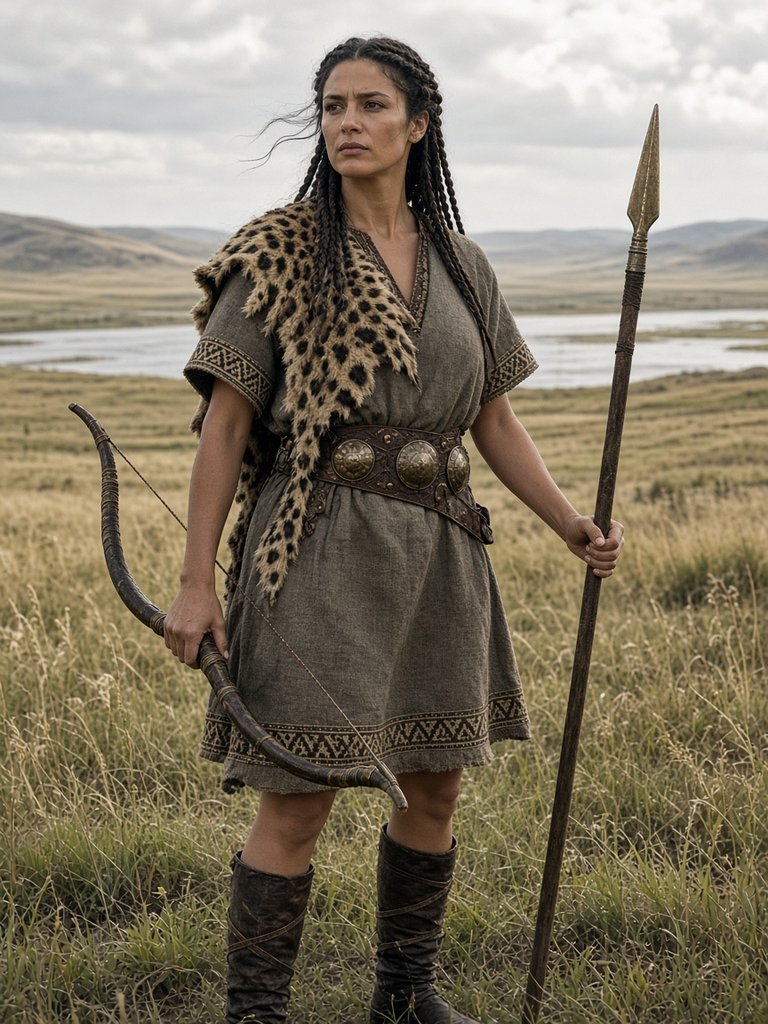
Hippolyte was queen of the Amazons, the warrior women who lived by the river Thermodon. She wore the war-belt of Ares, a sign of her rule, and for the ninth of his labours Herakles was sent by Eurystheus to bring it back for Admete, the king’s daughter (Apollodorus 2.5.9, paraphrased).
Apollodorus says that Hippolyte came to Herakles’ ship and promised him the belt, but Hera, disguised as an Amazon, spread the word that strangers were carrying off the queen. The Amazons attacked, and Herakles, believing he had been betrayed, killed Hippolyte and took the belt (Apollodorus 2.5.9, paraphrased). Euripides has Herakles win the golden-spangled belt in battle (Heracles 408–418, paraphrased).
Other writers link her with Theseus, who carried off an Amazon queen, called Antiope or Hippolyte, by whom he had Hippolytos; the Amazons then invaded Attica (Plutarch, Theseus 26–28, paraphrased). A later tradition says that Penthesileia killed her by accident while hunting, and came to Troy to be purified (Apollodorus, Epitome 5.1; Quintus Smyrnaeus 1.18–25, paraphrased).
Epithets
- Ἱππολύτη · Hippolytē
- she who lets the horses loose
Symbols and virtues
Martial queenship and a warrior people’s pride. Symbols: the war-belt of Ares, the bow, the spear.
Myths
- The belt of Ares. Apollodorus 2.5.9.
- Killed by Herakles. Apollodorus 2.5.9; Euripides, Heracles 408–418.
- Theseus and the Amazons. Plutarch, Theseus 26–28.
- Killed by Penthesileia. Apollodorus, Epitome 5.1; Quintus Smyrnaeus 1.18–25.
Sources
Euripides, Heracles 408–418; Diodorus 4.16; Apollodorus 2.5.9, Epitome 1.16, 5.1; Plutarch, Theseus 26–28; Quintus Smyrnaeus 1.18–25.
Quotations in public-domain translations (Evelyn-White 1914, Butler 1898/1900, Taylor 1792); other authors paraphrased.