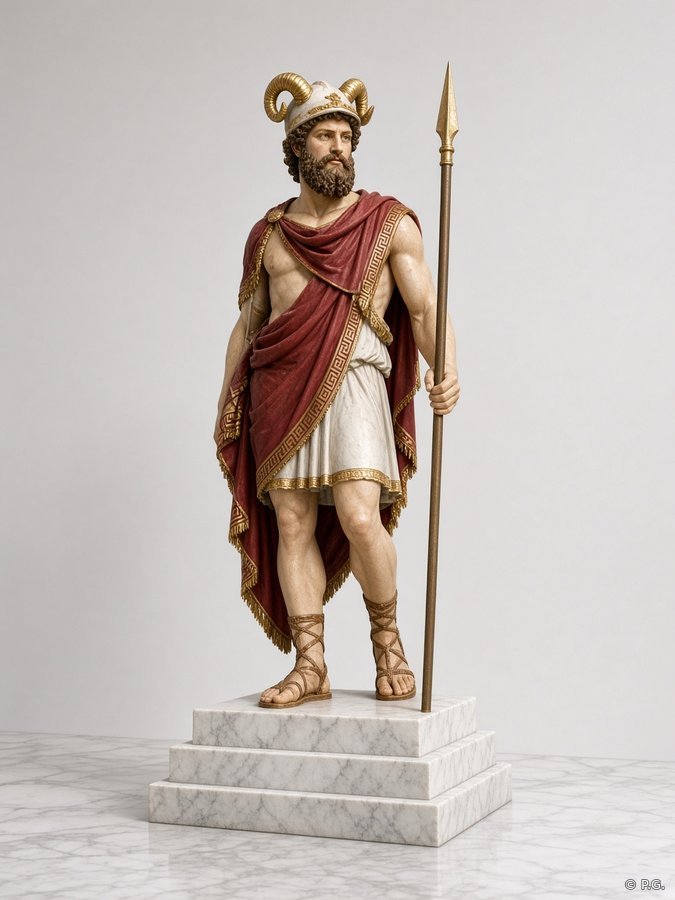
Kreios is one of the twelve Titans, born of Ouranos and Gaia (Theogony 134). He took as wife not a sister but a daughter of the sea: “Eurybia, bright goddess, was joined in love to Crius and bare great Astraeus, and Pallas, and Perses who also was eminent among all men in wisdom” (Theogony 375–377). Eurybia is a child of Pontos and Gaia, “who has a heart of flint within her” (Theogony 238–239).
Kreios’ sons are the fathers of whole families of gods. Astraios with Eos fathered the winds and the stars (Theogony 378–382); Pallas with Styx fathered Zelos, Nike, Kratos and Bia, who never leave the side of Zeus (Theogony 383–388); Perses with Asteria fathered Hekate (Theogony 409–411).
Epithets
- Κρεῖος · Kreios
- Titan, son of Ouranos and Gaia (Theogony 134)
Domains and symbols
Hesiod gives Kreios no domain beyond his family: the winds, the stars, Victory and Hekate descend from him. Admire: strength that founds a household. Sacred symbols: the stars and winds of his grandchildren.
Myths
- Born of Heaven and Earth. One of the twelve Titans (Theogony 133–138).
- Husband of Eurybia. Daughter of Pontos and Gaia (Theogony 238–239, 375).
- Father of Astraios, Pallas and Perses. Theogony 375–377.
- Grandfather of the winds and the stars. Through Astraios and Eos (Theogony 378–382).
- Grandfather of Nike and Kratos. Through Pallas and Styx (Theogony 383–388).
- Grandfather of Hekate. Through Perses and Asteria (Theogony 409–411).
Offerings
No cult of Kreios is recorded. Today: honour him with his grandchildren Nike and Hekate.
Beneath the Divine Mind
Kreios is the Divine Mind as a hidden root: the winds, the stars, Victory and Hekate all come down from him, though nothing is told of his own deeds. Like every god he stands beneath the One (The One and the Many).
Honouring Kreios today
- Lineage. When you honour Hekate or Nike, name Kreios among their forefathers.
- Patience. Honour the long work of building a family or a house.
- Hymn. Recite the Orphic hymn to the Titans below.
Hymn
O Mighty Titans, who from heav'n and earth derive your noble and illustrious birth, Our fathers fires, in Tartarus profound who dwell, deep merg'd beneath the solid ground: Fountains and principles, from whom began th' afflicted, miserable, race of man.Orphic Hymn 37, To the Titans, opening lines. Tr. Thomas Taylor (1792), public domain; divine names as given on Hemera.
Pallas Πάλλας
Titan, husband of Styx, father of Nike, Kratos, Bia and Zelos
Pallas the Titan is a son of Kreios and Eurybia and brother of Astraios and Perses (Theogony 375–377). With Styx, eldest daughter of Okeanos, he fathered the four powers who stand beside the throne of Zeus: “And Styx the daughter of Ocean was joined to Pallas and bare Zelus (Emulation) and trim-ankled Nike (Victory) in the house. Also she brought forth Cratos (Strength) and Bia (Force), wonderful children. These have no house apart from Zeus, nor any dwelling nor path except that wherein God leads them, but they dwell always with Zeus the loud-thunderer” (Theogony 383–388).
He is not Pallas the Giant whom Athena fought, nor the Pallas whose name Athena bears as an epithet. Through his children he gave Zeus the powers of his reign: Victory, Strength, Force and Zeal stand always beside the throne.
Epithets: Τιτάν · Titan (son of Kreios (Theogony 375–376))
Domains and symbols: The father of victory and might: power begotten in order to serve the just king. Admire: strength placed in the service of right. Sacred symbol: the waters of Styx, his wife.
Myths:
- Son of Kreios and Eurybia. Theogony 375–377.
- Children of Pallas and Styx. With Zelos, Nike, Kratos and Bia (Theogony 383–385).
- First to Zeus. Styx brings her children to Olympos before the war with the Titans, and Zeus makes them dwell with him for ever (Theogony 386–403).
“These have no house apart from Zeus, nor any dwelling nor path except that wherein God leads them, but they dwell always with Zeus the loud-thunderer.”Hesiod, Theogony 386–388, tr. H. G. Evelyn-White (1914), public domain. There is no Homeric or Orphic hymn to Pallas.
Sources: Hesiod, Theogony 375–377, 383–403. Ancient sources are cited by book and line or section in the standard numbering. Quotations from Hesiod and the Homeric Hymns are in the translation of H. G. Evelyn-White (1914), from Homer in the prose of Samuel Butler (Iliad 1898, Odyssey 1900), from the Orphic Hymns in that of Thomas Taylor (1792), all public domain; other ancient authors are paraphrased. Hemera gives each day's god in brief; this page is the temple's fuller account.
Sources
Hesiod, Theogony 133–138, 238–239, 375–388, 409–411; Orphic Hymn 37.
Quotations in public-domain translations (Evelyn-White 1914, Butler 1898/1900, Taylor 1792); other authors paraphrased.