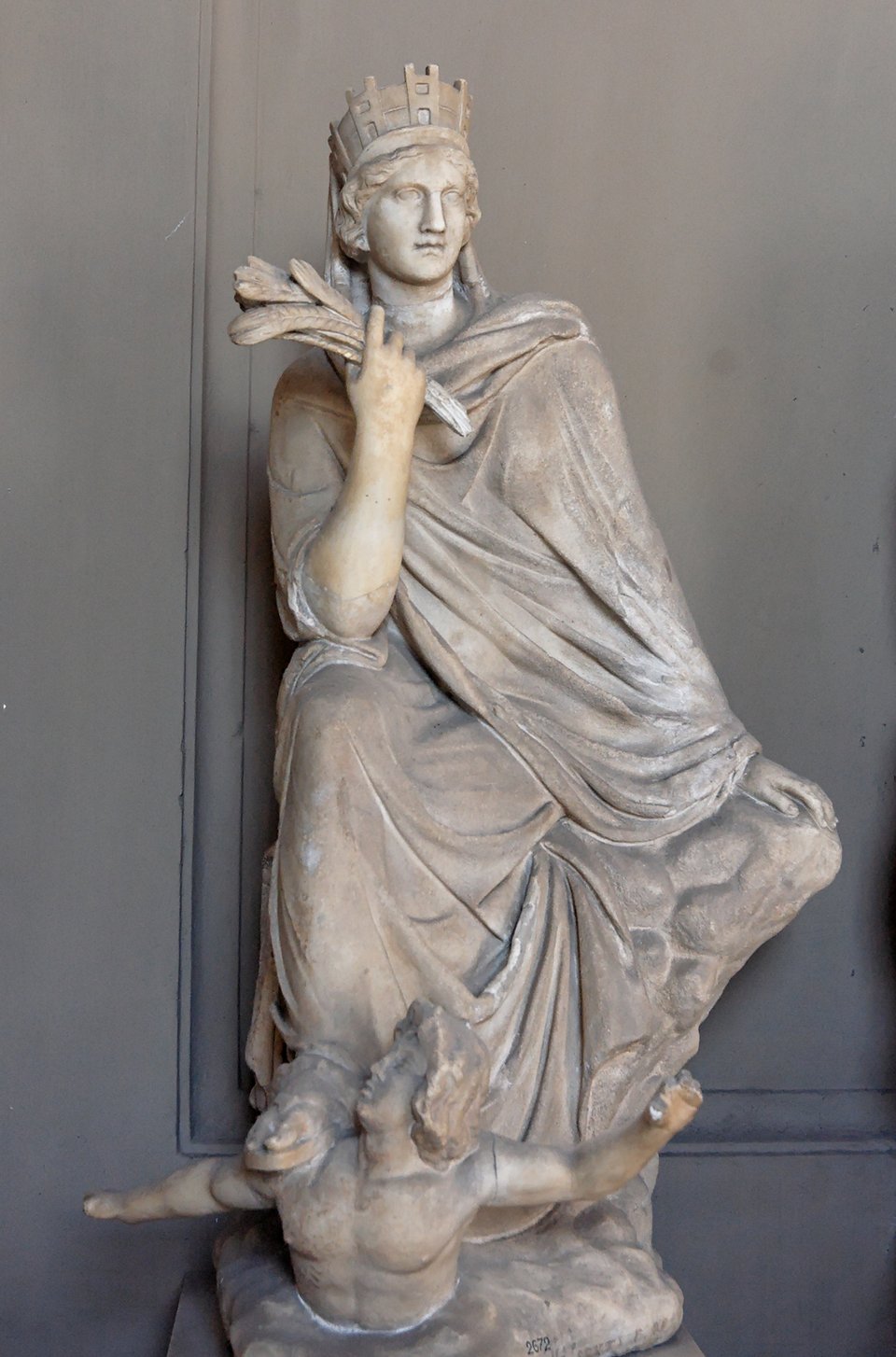
Jastrow, Public domain, via Wikimedia Commons

Tyche, “Fortune” or “Chance”, is in Hesiod one of the eldest daughters of Okeanos and Tethys: “Also she brought forth a holy company of daughters who with the lord Apollo and the Rivers have youths in their keeping -- to this charge Zeus appointed them” (Theogony 346–348), among them “Eudora, and Tyche, Amphirho, and Ocyrrhoe” (Theogony 360). In the Homeric Hymn to Demeter she is among Persephone’s companions in the meadow: “All we were playing in a lovely meadow, Leucippe and Phaeno and Electra and Ianthe, Melita also and Iache with Rhodea and Callirhoe and Melobosis and Tyche and Ocyrhoe, fair as a flower” (Homeric Hymn 2.417–420). Pausanias notes that this hymn is the first poem to name her, as a daughter of Okeanos (Pausanias 4.30.4, paraphrased).
Later Greeks made her a great goddess, the power of fortune that rules the fates of men and cities. Pindar calls her the saviour, daughter of Zeus the Deliverer, who steers swift ships at sea and wars and assemblies on land (Olympian 12.1–5, paraphrased); elsewhere, Pausanias says, he counted her one of the Moirai and the strongest of them. Boupalos made her first statue, for Smyrna, with the polos on her head and the horn of Amaltheia in her hand (Pausanias 4.30.6, paraphrased). At Aigeira she held the horn of Amaltheia with winged Eros beside her (Pausanias 7.26.8, paraphrased), and Eutychides’ Tyche of Antioch, with the river Orontes at her feet, was highly valued by the Syrians (Pausanias 6.2.7, paraphrased). Agathe Tyche, Good Fortune, received offerings across the Greek world, and the Romans honoured her as Fortuna.
Epithets
- Σώτειρα · Soteira
- saviour (Pindar, Olympian 12.2)
- Ἀγαθὴ Τύχη · Agathe Tyche
- Good Fortune
Domains and symbols
Fortune, chance, the luck of cities. Admire: courage in change, gratitude in success, steadiness in loss. Sacred symbols: the horn of plenty, the rudder, the wheel, the turreted crown.
Myths
- Daughter of Okeanos and Tethys. Theogony 360.
- Persephone’s companion. Homeric Hymn to Demeter 420.
- Saviour of ships and cities. Pindar, Olympian 12.1–5.
- Strongest of the Moirai. Pindar in Pausanias 4.30.6.
- With the infant Ploutos. At Thebes (Pausanias 9.16.2).
Cult sites
- Smyrna. Statue by Boupalos (Pausanias 4.30.6).
- Aigeira. Tyche with the horn of Amaltheia and Eros (Pausanias 7.26.8).
- Antioch. The Tyche of Eutychides (Pausanias 6.2.7).
Offerings
Tyche received libations, incense and first-fruits, and cities kept shrines to their own Fortune. Today: give thanks for good fortune, and share it.
Beneath the Divine Mind
Tyche is the Divine Mind as it meets us in time: what comes unasked, good or ill, through which the soul learns steadiness. Like every god she stands beneath the One (The One and the Many).
Honouring Tyche today
- Thanks. Give thanks for a piece of good luck.
- Share. Share your good fortune.
- Steady. Meet a setback calmly.
Hymn
“Approach strong Fortune, with propitious mind and rich abundance, to my pray'r inclin'd”Orphic Hymn 72, To Tyche (Fortune), opening lines. Tr. Thomas Taylor (1792), public domain.
Sources
Hesiod, Theogony 346–366; Homeric Hymn to Demeter 417–424; Pindar, Olympian 12.1–12; Pausanias 4.30.4–6, 6.2.7, 7.26.8, 9.16.2; Orphic Hymn 72.
Quotations in public-domain translations (Evelyn-White 1914, Butler 1898/1900, Taylor 1792); other authors paraphrased.