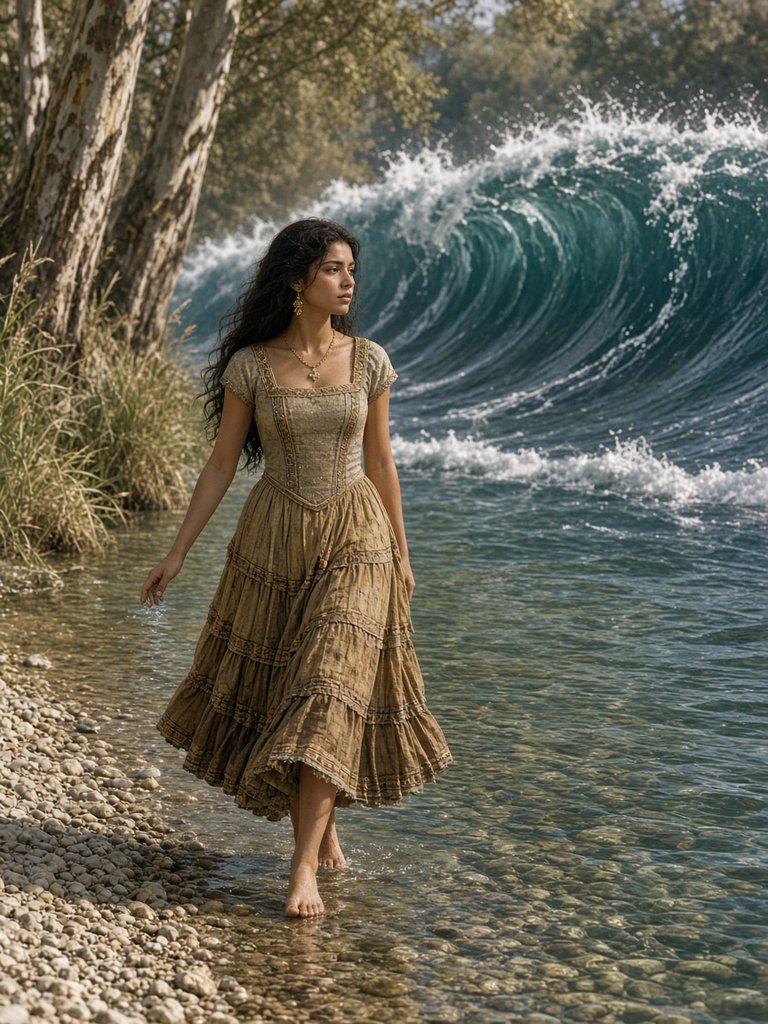
Tyro is the first of the heroines whom Odysseus meets in the underworld: “The first I saw was Tyro. She was daughter of Salmoneus and wife of Cretheus the son of Aeolus. She fell in love with the river Enipeus who is much the most beautiful river in the whole world” (Odyssey 11.235–239, tr. Butler).
Poseidon took the shape of the river and lay with her at its mouth, where “a huge blue wave arched itself like a mountain over them to hide both woman and god” (Odyssey 11.241–244, tr. Butler). She bore twin sons, Pelias, who became king of Iolkos and sent Jason for the Golden Fleece, and Neleus, king of Pylos and father of Nestor. To Cretheus she bore Aison, father of Iason, as well as Pheres and Amythaon (Odyssey 11.254–259).
Sophocles wrote two lost plays about her. In the version told by Apollodorus she exposed the twins, was cruelly treated by her stepmother Sidero, and was rescued by her sons when they were grown (Apollodorus 1.9.8, paraphrased).
Epithets
- Σαλμωνηΐς · Salmōnēïs
- daughter of Salmoneus
- εὐπατέρεια · eupatereia
- daughter of a noble father (Odyssey 11.235)
Symbols and virtues
Love for a river and the birth of royal lines. Symbols: the river Enipeus, the arching wave.
Myths
- Poseidon in the river. Odyssey 11.235–252.
- Mother of Pelias and Neleus. Odyssey 11.253–259.
- Sidero. Apollodorus 1.9.8.
In the poets
“The first I saw was Tyro. She was daughter of Salmoneus and wife of Cretheus the son of Aeolus.”Homer, Odyssey 11.235–237, tr. Samuel Butler (1900), public domain.
Sources
Homer, Odyssey 2.120, 11.235–259; Apollodorus 1.9.8–11; Sophocles, Tyro (fragments).
Quotations in public-domain translations (Evelyn-White 1914, Butler 1898/1900, Taylor 1792); other authors paraphrased.